Gender Stereotypes in Assigning Physical Education Roles: Evidence from Islamic Primary Schools
DOI:
https://doi.org/10.59698/spectapro.v1i2.604Keywords:
Gender Stereotypes, Class Teacher, Madrasah Ibtidaiyah, Physical EducationAbstract
Background of study: Gender stereotypes continue to significantly influence educational management, particularly within the context of religious-based primary schools.
Aims and scope of paper: This study aims to analyze how gender-based perceptions dictate the assignment of non-specialist class teachers as Physical Education instructors in Madrasah Ibtidaiyah.
Methods: Employing a qualitative descriptive case study, research was conducted at a private Madrasah Ibtidaiyah in Salatiga. Data were gathered through participatory observation, documentation, and semi-structured interviews with male and female class teachers representing both lower and upper grade levels.
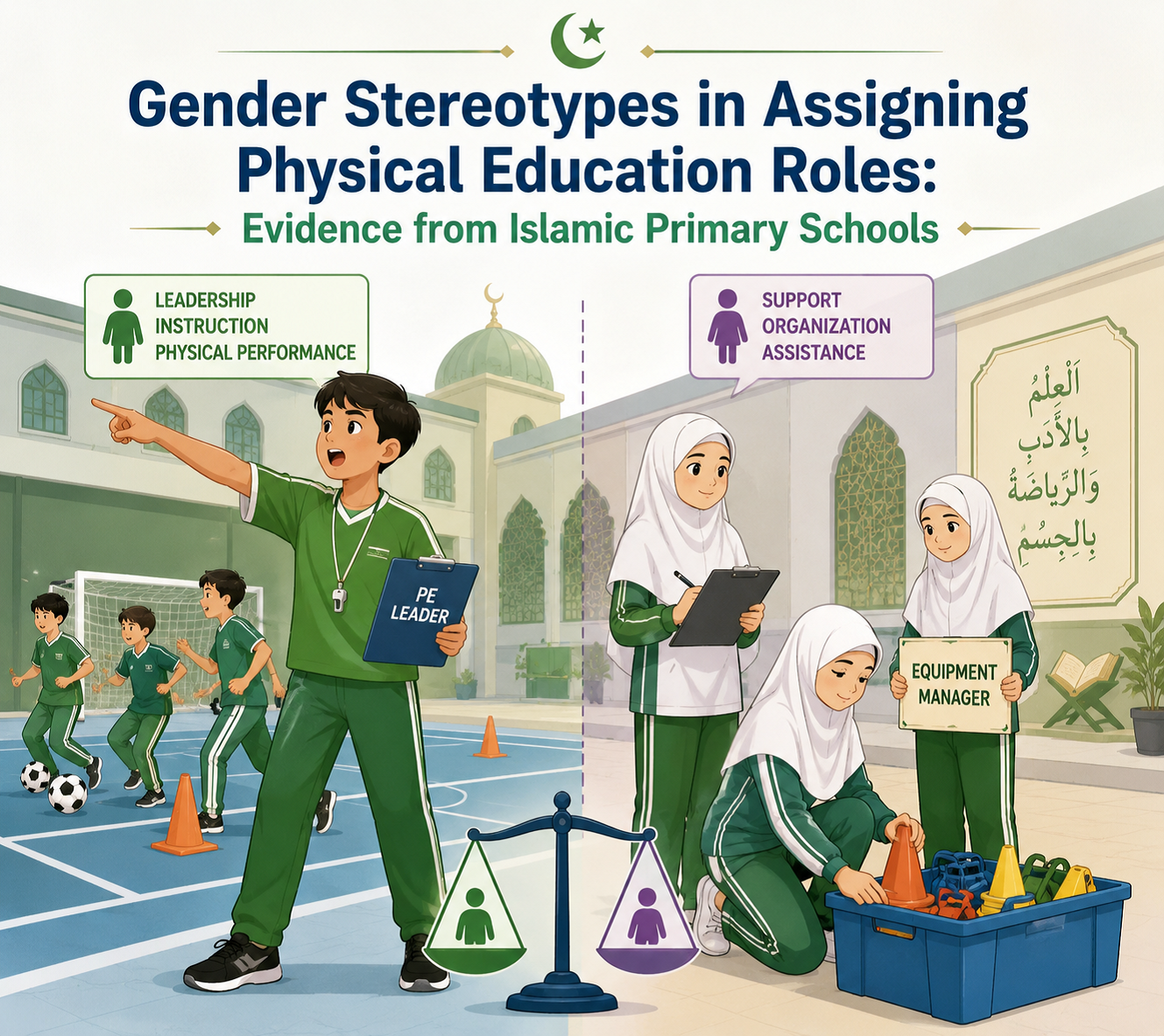
Results: Findings reveal a systematic segregation where female teachers are exclusively assigned to lower grades based on nurturing stereotypes. In contrast, male teachers dominate upper grades due to perceived physical authority and masculine dominance. This distribution is driven by social role expectations rather than formal professional competence. The analysis indicates that these practices reproduce traditional gender schemas within the sports field, limiting teachers' professional development and reinforcing gender biases among students. Madrasah management tends to rely on intuitive gender roles rather than pedagogical standards, creating an invisible barrier to female educators in athletic instruction.
Conclusion: The study concludes that such stereotypical assignments undermine the inclusivity of physical education. It implies an urgent need for gender-responsive managerial policies and cross-gender teacher rotations to dismantle these ingrained biases. This research contributes a significant perspective on the mechanism of gender reproduction within Islamic primary education management.
References
Archey, X. (2022). More than Words: Teacher Candidates Turn and Talk about the Hidden Messages in Children’s Literature. International Journal of Multicultural Education, 24(1), 16–26. https://doi.org/10.18251/IJME.V24I1.2395
Basma, L., & Rubie-Davies, C. M. (2025). Parents’ and teachers’ gender role attitudes and perceptions of mathematics achievement in Lebanon: bias against girls. Mathematics Education Research Journal. https://doi.org/10.1007/s13394-025-00549-w
Camacho, L., Salinas, C., Vasquez, M. C., Rodriguez, S. L., & Izaguirre Peña, J. (2023). A values based leadership approach to (re)defining Latino manhood and masculinity. International Journal of Leadership in Education, 26(4), 645–665. https://doi.org/10.1080/13603124.2020.1862921
Creswell, J. W. (2018). Research Design: Qualitative, Quantitative, and Mixed Methods Approaches (5th ed.). SAGE Publications.
del Castillo Andrés, Ó., Granados, S. R., Ramírez, T. G., & del Carmen Campos Mesa, M. (2012). Gender Equity in Physical Education: The Use of Information. Sex Roles, 67(1–2), 108–121. https://doi.org/10.1007/s11199-011-0103-5
Farago, F., Martin, C. L., Granger, K. L., Santos, C. E., & Miller, C. F. (2022). Teachers’ Gender-Role Attitudes and Gendered Classroom Practices. Sex Roles 2022 87:9, 87(9), 471–486. https://doi.org/10.1007/S11199-022-01331-Z
Fjellner, R. L., Varea, V., & Barker, D. (2024). How physical education teachers are positioned in models scholarship: a scoping review. Physical Education and Sport Pedagogy, 29(4), 329–345. https://doi.org/10.1080/17408989.2022.2083098
Franke, G. R., Crown, D. F., & Spake, D. F. (1997). Gender differences in ethical perceptions of business practices: A social role theory perspective. Journal of Applied Psychology, 82(6), 920–934. https://doi.org/10.1037/0021-9010.82.6.920
Gajda, A., Bójko, A., & Stoecker, E. (2022). The vicious circle of stereotypes: Teachers’ awareness of and responses to students’ gender-stereotypical behaviour. PLOS ONE, 17(6), e0269007. https://doi.org/10.1371/JOURNAL.PONE.0269007
Gilchrist, E., & Zhang, K. C. (2024). Gender Stereotypes in the UK Primary Schools: Student and Teacher Perceptions. International Journal of Educational Reform, 33(3), 270–294. https://doi.org/10.1177/10567879221114889
Ibrahim, E., Sa’adi, & Nugroho, A. (2026). Menemukan Kembali Jiwa Pendidikan Islam: Refleksi atas Filsafat Bebas Kreatif Muhammad Iqbal. Ma’rifah: Jurnal Pendidikan Islam, 2(1), 1–20. https://doi.org/10.65951/MJPI.V2I1.14
Işıkgöz, M. E., Şahbudak, M., Deveci, M. E., & Öztunç, M. (2025). Challenges and successes in promoting gender equality through physical education and sports: a systematic review. BMC Public Health 2025 25:1, 25(1), 2117-. https://doi.org/10.1186/S12889-025-23373-0
Kim, M., & Hodge, S. R. (2024). Curricular and pedagogical barriers to South Korean female students’ physical activity in physical education class. International Journal of Inclusive Education, 28(6), 875–890. https://doi.org/10.1080/13603116.2021.1968517
Laili, R. N., Listyani, R. H., & Agzumi, G. (2024). The dual role of women in raising family social status through education: A perspective of Edward Wilson’s nurture theory. AL MA’ARIEF : Jurnal Pendidikan Sosial Dan Budaya, 6(2), 73–83. https://doi.org/10.35905/ALMAARIEF.V6I2.11325
Lievore, I., & Triventi, M. (2023). Do teacher and classroom characteristics affect the way in which girls and boys are graded? British Journal of Sociology of Education, 44(1), 97–122. https://doi.org/10.1080/01425692.2022.2122942
Pastor-Vicedo, J. C., Sánchez-Oliva, A., Sánchez-Blanchart, J., & Martínez-Martínez, J. (2019). Gender stereotypes in physical education. Sport TK, 8(2), 23–32. https://doi.org/10.6018/sportk.401071
Pautu, A., Petracovschi, S., & Domokos, M. (2025). The impact of gender stereotypes on physical education lessons: a pilot study regarding the qualitative analysis of teachers’ perceptions. Frontiers in Psychology, 16. https://doi.org/10.3389/fpsyg.2025.1575686
Preece, S., & Bullingham, R. (2022). Gender stereotypes: the impact upon perceived roles and practice of in-service teachers in physical education. Sport, Education and Society, 27(3), 259–271. https://doi.org/10.1080/13573322.2020.1848813
Sari, N., Hardiyanto, A., Suhariyanti, M., Jasmani, P., Kotabumi, U. M., Hasan, J., Ratu, K., 1052, N., Sari, S., Kotabumi, L., & Utara, L. 34517. (2025). Partisipasi Perempuan Dalam Pendidikan Jasmani: Tinjauan Literatur Gender. Aisyah Journal Of Physical Education (AJoPE) e-ISSN : 3046-790X, 4(2), 42–47. https://doi.org/10.30604/AJOPE.V4I2.2069
Sumarjono, Nopembri, S., & Yuliarto, H. (2024). Genealogy on Policies and Strategies of Physical Education for Elementary Schools in Indonesia. Retos, 57, 416–425. https://doi.org/10.47197/RETOS.V57.104741
Yang, Y., Yu, H., & You, S. (2026). Beyond stereotypes: gendered pathways in academic self-perception and teacher identity formation in Chinese Physical Education programs. Frontiers in Psychology, 16, 1727557. https://doi.org/10.3389/FPSYG.2025.1727557/TEXT
Downloads
Published
Issue
Section
License
Copyright (c) 2025 Choirul Anwar, Ahmad Faiz Abdillah, Muhammad Syahrul Muharram, Istianatul Milah

This work is licensed under a Creative Commons Attribution-ShareAlike 4.0 International License.
Spectapro: Journal of Cultural Currents in Physical Education and Sport Evolution




.png)