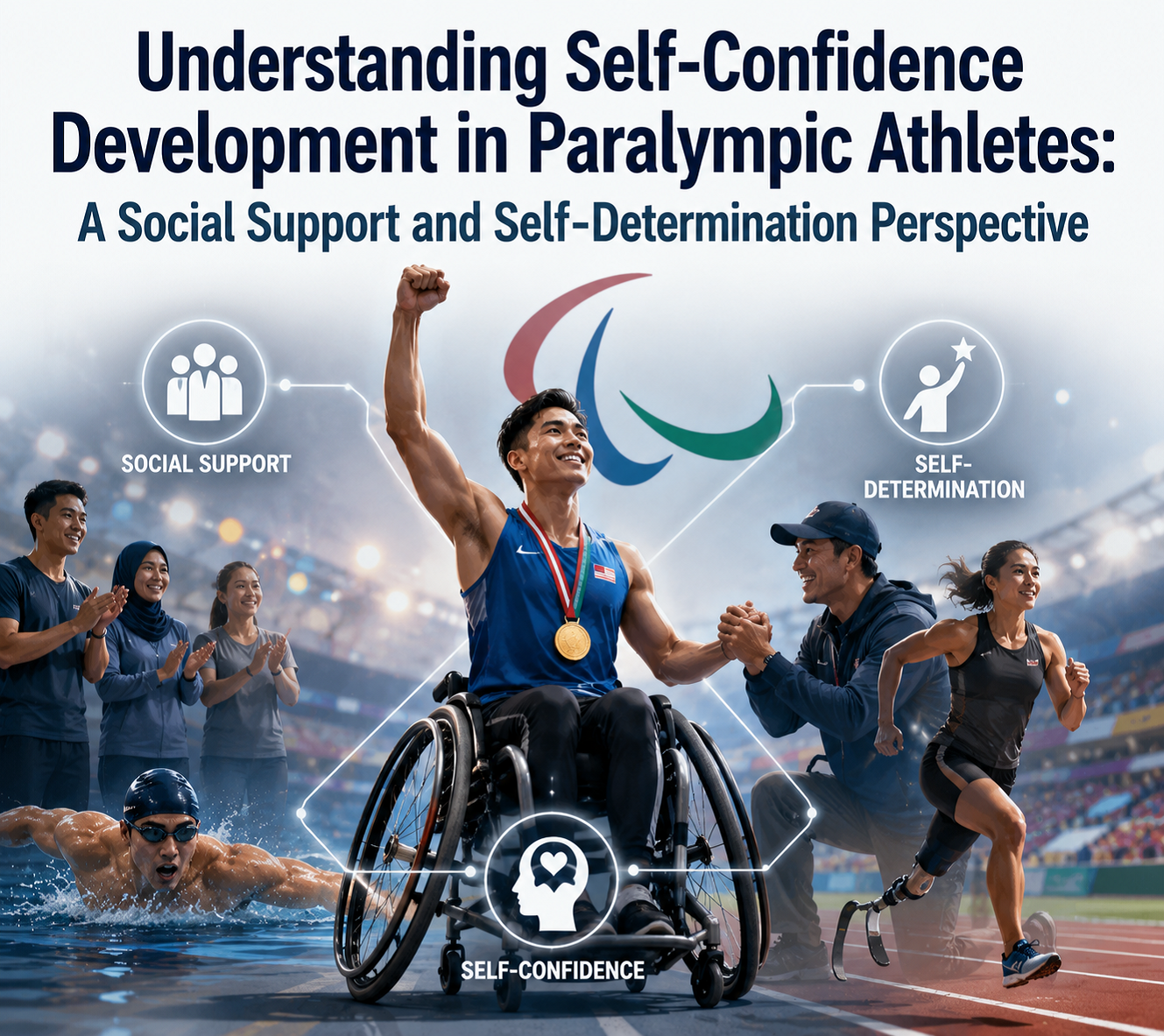
Understanding Self-Confidence Development in Paralympic Athletes: A Social Support and Self-Determination Perspective
DOI:
https://doi.org/10.59698/spectapro.v1i2.602Keywords:
Paralympic Athletes, Self-Confidence, Social Support, Coaching, Peer SupportAbstract
Background of study: Self-confidence is a critical psychological factor that influences athletic performance, particularly in Paralympic sports where athletes encounter both physical and mental challenges.
Aims and scope of paper: This study aims to examine the influence of social support (namely coach, family, and peer support) on the self-confidence of Paralympic weightlifting athletes.
Methods: A quantitative survey design was employed, involving athletes selected through purposive sampling. Data were collected using a structured questionnaire based on a five-point Likert scale. The data were analyzed using descriptive statistics, Pearson correlation, and multiple linear regression.
Results: The findings indicate that all variables are in the high to very high category, with coach support demonstrating the highest mean score, followed by self-confidence and peer support. Family support shows relatively lower scores, particularly in emotional support during failure or injury. Correlation analysis reveals that coach and peer support have strong positive relationships with self-confidence, while family support shows a moderate relationship. Regression results confirm that all three variables significantly predict self-confidence, with coach support emerging as the most dominant factor.
Conclusion: This study concludes that a multidimensional social support system (particularly coach support) plays a critical role in shaping self-confidence among Paralympic weightlifting athletes. The integration of coach, peer, and family support significantly enhances athlete self-efficacy, highlighting the importance of a holistic psychosocial environment to sustain confidence and competitive resilience in elite disability sports.
References
Alkasasbeh, W. J., & Akroush, S. H. (2025). Sports motivation: a narrative review of psychological approaches to enhance athletic performance. Frontiers in Psychology, Volume 16-2025.
Andrews, R. W., Lilly, J. M., Srivastava, D., & Feigh, K. M. (2023). The role of shared mental models in human-AI teams: a theoretical review. Theoretical Issues in Ergonomics Science, 24(2), 129–175. https://doi.org/10.1080/1463922X.2022.2061080
Bandura, A. (2013). Self-Efficacy: The foundation of agency1. In Control of human behavior, mental processes, and consciousness (hal. 16–30). Psychology Press.
Bissell, K., Billings, A. C., & Park, B. (2022). Sports media as empathy facilitator: The contrasting influence of paralympic and olympic content. International Journal of Sport Communication, 15(2), 148–157. https://doi.org/10.1123/ijsc.2022-0009
Chen, B., Li, H., & Zhang, R. (2025). The mechanism of peer support on the mental toughness of adolescent swimmers: the mediating role of self-efficacy. Frontiers in Psychology, 16.
Donkoh, S. (2023). Sources of self-efficacy and their implications on science teacher education. European Journal of Education Studies, 10(9), 447–459. https://doi.org/10.46827/ejes.v10i9.5002
Ellmer, E. M. M. (2025). Conquering fear to pedal forward: emotions and learning in high-risk sports. Sport, Education and Society, 1–14. https://doi.org/10.1080/13573322.2025.2568038
Freire, G. L. M., Nascimento Junior, J. R. A. do, Cronin, L. D., Gomes Costa, N. L., & Fiorese, L. (2025). The coach-athlete relationship as a mediator of the relationships between coach–autonomy support and athlete’s life skills development. International Journal of Sports Science & Coaching, 20(3), 899–909. https://doi.org/10.1177/17479541241308650
Ganotice, F. A., Chan, L., Shen, X., Lam, A. H. Y., Wong, G. H. Y., Liu, R. K. W., & Tipoe, G. L. (2022). Team cohesiveness and collective efficacy explain outcomes in interprofessional education. BMC Medical Education, 22(1), 820. https://doi.org/10.1186/s12909-022-03886-7
Henriksen, K., Dideriksen, S., Kuettel, A., Schlawe, A., & Storm, L. K. (2025). The coach as an architect of Danish high- performance sport environments. Psychology of Sport and Exercise, 80, 102877. https://doi.org/https://doi.org/10.1016/j.psychsport.2025.102877
Lemelin, E., Verner-Filion, J., Carpentier, J., Carbonneau, N., & Mageau, G. A. (2022). Autonomy support in sport contexts: The role of parents and coaches in the promotion of athlete well-being and performance. Sport, Exercise, and Performance Psychology, 11(3), 305. https://doi.org/10.1037/spy0000287
Likert, R. (1932). A technique for the measurement of attitudes. Archives of psychology.
Liu, J., Yu, H., Cheung, W. C., Bleakney, A., & Jan, Y.-K. (2025). Societal attitudes and structural barriers in coaching para-athletes: A mixed-methods systematic review. PloS one, 20(6), e0326585. https://doi.org/10.1371/journal.pone.0326585
Martela, F., Lehmus-Sun, A., Parker, P. D., Pessi, A. B., & Ryan, R. M. (2023). Needs and well-being across Europe: Basic psychological needs are closely connected with well-being, meaning, and symptoms of depression in 27 European countries. Social Psychological and Personality Science, 14(5), 501–514. https://doi.org/10.1177/19485506221113678
Pankowiak, A., Brockett, C., De Bosscher, V., & Westerbeek, H. (2023). National Paralympic sport policies influencing a country’s Paralympic success. International Journal of Sport Policy and Politics, 15(3), 435–455. https://doi.org/10.1080/19406940.2023.2196992
Piggott, L. V, & Matthews, J. J. K. (2024). Gender representation and policy implementation in the governance of international paralympic organizations. In Research Handbook on Gender and Diversity in Sport Management (hal. 37–51). Edward Elgar Publishing. https://doi.org/10.4337/9781802203691.00011
Quinn, N., Misener, L., & Howe, P. D. (2022). All for one and one for all? Integration in high-performance sport. Managing Sport and Leisure, 27(6), 558–576. https://doi.org/10.1080/23750472.2020.1829989
Robazza, C., Vitali, F., Bortoli, L., & Ruiz, M. C. (2025). Self-confidence, mental toughness, and psychobiosocial experiences in elite rugby players. Psychology of Sport and Exercise, 77, 102798. https://doi.org/https://doi.org/10.1016/j.psychsport.2024.102798
Shiralian, Setareh, Talebi, Kambiz, Ghodratizadeh, Faraz, & Chitsaz, Ehsan. (2025). The role of design thinking in promoting innovative behavior: An exploration of team cohesion and motivation. Journal of General Management, 03063070251322856. https://doi.org/10.1177/03063070251322856
Sugiyono. (2013). Metode Penelitian Kuantitatif Kualitatif dan R&D (Cetakan 19). ALFABETA.
Volgemute, K., Ulme, G., Abele, A., Vazne, Z., Ansons, K., Licis, R., Lavins, R., & Klonova, A. (2026). Multi-factorial profiling of athletes integrating personality, psychological skills, and Psychophysiological performance indicators. Scientific Reports, 16(1), 4949. https://doi.org/10.1038/s41598-026-35809-7
Zhang, J., Qu, Q., & Chen, X.-B. (2023). A review on collective behavior modeling and simulation: building a link between cognitive psychology and physical action. Applied Intelligence, 53(21), 25954–25983. https://doi.org/10.1007/s10489-023-04924-7
Downloads
Published
Issue
Section
License
Copyright (c) 2025 Daryanto, Dasih Ayu Wulansari

This work is licensed under a Creative Commons Attribution-ShareAlike 4.0 International License.
Spectapro: Journal of Cultural Currents in Physical Education and Sport Evolution



.png)