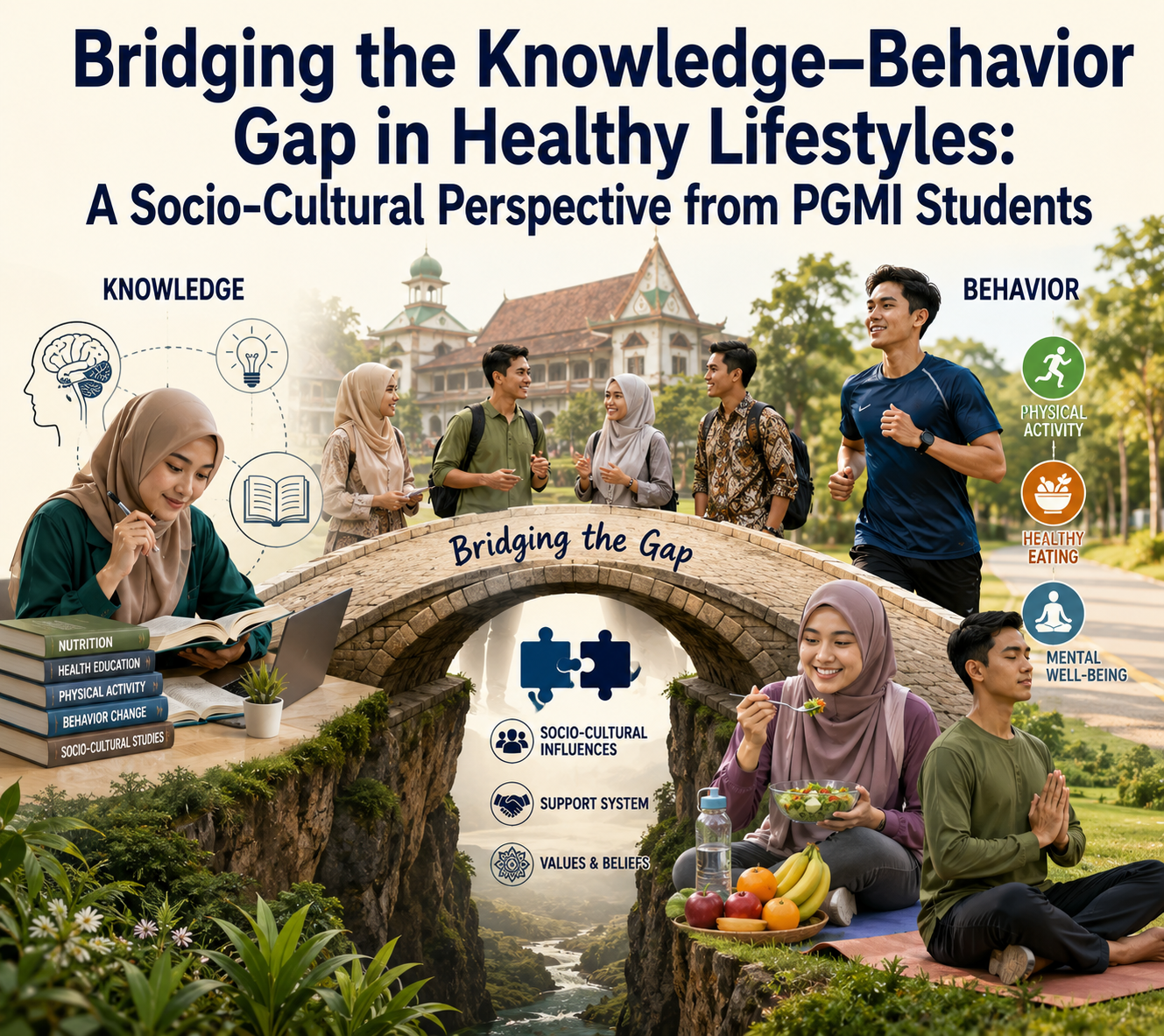
Bridging the Knowledge–Behavior Gap in Healthy Lifestyles: A Socio-Cultural Perspective from PGMI Students Salatiga
DOI:
https://doi.org/10.59698/spectapro.v1i2.601Keywords:
Health Knowledge, Healthy Lifestyle Behavior, Attitude, Physical EducationAbstract
Background of study: Healthy lifestyle practices are an essential component of Physical Education (PJOK), particularly for prospective teachers who are expected to become role models for their students. However, previous studies indicate a discrepancy between health awareness and actual behavior among university students.
Aims and scope of paper: This study aims to examine the relationship between knowledge, attitudes, and healthy lifestyle behaviors among students of the Primary School Teacher Education Program (PGMI) at UIN Salatiga.
Methods: A quantitative descriptive approach was employed, involving 112 students who completed a Likert-scale questionnaire measuring health knowledge, attitudes, and behaviors. The data were analyzed using descriptive statistics, particularly mean scores.
Results: The findings show that students have high levels of health knowledge, particularly regarding the benefits of physical activity (M = 4.74), balanced nutrition (M = 4.70), and awareness of the role of teachers as health role models (M = 4.57). Students also demonstrate positive attitudes toward healthy living. However, the implementation of healthy behaviors remains moderate, especially in routine health check-ups (M = 3.14) and regular exercise habits (M = 3.34), indicating a gap between knowledge, attitudes, and actual practices.
Conclusion: The study concludes that although students possess strong knowledge and positive attitudes, these are not consistently reflected in their behavior. Therefore, it is necessary to strengthen behavioral support, self-regulation, and environmental factors within Physical Education learning to promote sustainable healthy lifestyle practices among future teachers.
References
Abbasi, M., Shirazi, M., Torkmandi, H., Homayoon, S., & Abdi, M. (2023). Impact of teaching, learning, and assessment of medical law on cognitive, affective and psychomotor skills of medical students: a systematic review. BMC Medical Education, 23(1), 703. https://doi.org/10.1186/s12909-023-04695-2
Alves, R. F. (2024). The relationship between health-related knowledge and attitudes and health risk behaviours among Portuguese university students. Global Health Promotion, 31(1), 36–44.
Ammar, A., Boujelbane, M. A., Salem, A., Trabelsi, K., Bouaziz, B., Kerkeni, M., Masmoudi, L., Heydenreich, J., Schallhorn, C., Müller, G., Uyar, A. M., Ghazzawi, H. A., Amawi, A. T., Orhan, B. E., Grosso, G., Abdelkarim, O., Aly, M., Driss, T., El Abed, K., … Schöllhorn, W. I. (2025). Exploring Determinants of Mediterranean Lifestyle Adherence: Findings from the Multinational MEDIET4ALL e-Survey Across Ten Mediterranean and Neighboring Countries. In Nutrients (Vol. 17, Nomor 14, hal. 2280). https://doi.org/10.3390/nu17142280
Asrofik, Rahmawati, I., Rozak, A. K., & Amiruddin, M. (2024). Kebudayaan Kesehatan Islam: Tinjauan Sejarah dan Relevansinya dalam Kesehatan Masyarakat Kontemporer. Ameena Journal, 2(3), 280–297. https://doi.org/10.63732/aij.v2i3.107
Bantjes, J., Hunt, X., & Stein, D. J. (2022). Public Health Approaches to Promoting University Students’ Mental Health: A Global Perspective. Current Psychiatry Reports, 24(12), 809–818. https://doi.org/10.1007/s11920-022-01387-4
Bates, R., Brenner, B., Schmid, E., Steiner, G., & Vogel, S. (2022). Towards meta–competences in higher education for tackling complex real–world problems – a cross disciplinary review. International Journal of Sustainability in Higher Education, 23(8), 290–308. https://doi.org/10.1108/IJSHE-06-2021-0243
Burgess, A., Yeomans, H., & Fenton, L. (2022). ‘More options…less time’ in the ‘hustle culture’ of ‘generation sensible’: Individualization and drinking decline among twenty-first century young adults. The British Journal of Sociology, 73(4), 903–918. https://doi.org/https://doi.org/10.1111/1468-4446.12964
Darmayanti, R., & Farida, F. (2025). Permainan Tradisional Dakon untuk Meningkatkan Kemampuan Berhitung Dasar dan Keterampilan Sosial Siswa Kelas 2 SD (SDGs 4 & SDGs 3). Jurnal Penelitian Tindakan Kelas, 3(1), 7–16. https://doi.org/10.61650/jptk.v3i1.761
Emilia, O., Suhoyo, Y., & Utomo, P. S. (2023). Teacher as role model in developing professional behavior of medical students: a qualitative study. International Journal of Medical Education, 14, 55–62. https://doi.org/10.5116/ijme.6443.ae49
Fenwick, A., Molnar, G., & Frangos, P. (2024). The critical role of HRM in AI-driven digital transformation: a paradigm shift to enable firms to move from AI implementation to human-centric adoption. Discover Artificial Intelligence, 4(1), 34. https://doi.org/10.1007/s44163-024-00125-4
Ganotice, F. A., Chan, L., Shen, X., Lam, A. H. Y., Wong, G. H. Y., Liu, R. K. W., & Tipoe, G. L. (2022). Team cohesiveness and collective efficacy explain outcomes in interprofessional education. BMC Medical Education, 22(1), 820. https://doi.org/10.1186/s12909-022-03886-7
Huang, X., & Wang, C. (2024). Pre-service teachers’ professional identity transformation: a positioning theory perspective. Professional Development in Education, 50(1), 174–191. https://doi.org/10.1080/19415257.2021.1942143
Hung, S.-T., Cheng, Y.-C., Wu, C.-C., & Su, C.-H. (2023). Examining Physical Wellness as the Fundamental Element for Achieving Holistic Well-Being in Older Persons: Review of Literature and Practical Application in Daily Life. Journal of Multidisciplinary Healthcare, 16(null), 1889–1904. https://doi.org/10.2147/JMDH.S419306
Ismawi, F. N., & Shaari, A. A. H. (2024). Tekanan Akademik Dan Kestabilan Emosi: Analisis Kualitatif Dalam Kalangan Mahasiswa Universiti Kebangsaan Malaysia. Jurnal Wacana Sarjana, 8(5), 1–14. https://doi.org/10.17576/jws.v8i5.615
Mubango, H., & Ngirande, H. (2025). Self-Regulated Learning: Time Management in a Blended Learning. Self-Regulated Learning-Insights and Innovations: Insights and Innovations, 153.
Noaime, E., Alshenaifi, M., Albaqawy, G., Abuhussain, M. A., Abdelhafez, M. H., & Alnaim, M. M. (2025). Beyond Buildings: How Does Sustainable Campus Design Shape Student Lives? Hail University as a Case Study. In Buildings (Vol. 15, Nomor 9, hal. 1468). https://doi.org/10.3390/buildings15091468
Patzak, A., Zhang, X., & Marzouk, Z. (2025). From Research to Practice: Facilitating Time Management Instruction in Higher Education. College Teaching, 1–8. https://doi.org/10.1080/87567555.2025.2495681
Ramadhani, D. A., Meidiah, A. N. S., Ramadani, N. O., Yusuf, M., Zulihi, Z., Taslim, M., & Efendy, D. (2025). Keterbatasan Transportasi dan Kendala Anak Sekolah dalam Mengakses Pendidikan di Kampung Pisang Kota Jayapura. Jurnal Pendidikan dan Pembelajaran Indonesia (JPPI), 5(2), 681–692. https://doi.org/10.53299/jppi.v5i2.1353
Shoranov, M., Ibrayeva, A., Alchinbayev, M., Sadykov, B., Ismoldayev, Y., Izdenov, A., Fakhradiyev, I., Lee, S., & Tanabayeva, S. (2026). Association Between Socio-Demographic, Behavioural, and Health-Related Factors and Fruit, Vegetable, and Salt Consumption Among Adults Aged 18–69 Years in Kazakhstan: A Cross-Sectional Study. In Nutrients (Vol. 18, Nomor 7, hal. 1154). https://doi.org/10.3390/nu18071154
Sukartidana, I. N., & Anam, K. (2025). Hubungan Antara Kebugaran Fisik, Beban Akademik, Gaya Hidup Sedentari, dan Aktivitas Fisik terhadap Tingkat Kebugaran Mahasiswa. Jurnal Pendidikan Jasmani, Kesehatan, dan Rekreasi, 3(1), 69–77. https://doi.org/10.59584/jurnalpjkr.v3i1.91
Wang, J. (2026). Influence of mental health education curricula on pre-service teachers’ professional identity: content analysis, value, and practical pathways. Journal of Education for Teaching, 52(2), 250–266. https://doi.org/10.1080/02607476.2025.2563699
Yau, Y., & Shen, Y. C. (2025). “Though helpful, still hesitant”: a TAM-based qualitative study on older adults’ ambivalent acceptance and model extensions in AI fitness coaches. Frontiers in Psychology, Volume 16-2025.
Downloads
Published
Issue
Section
License
Copyright (c) 2025 Yulia Ratimiasih, Bertika Kusuma Prastiwi

This work is licensed under a Creative Commons Attribution-ShareAlike 4.0 International License.
Spectapro: Journal of Cultural Currents in Physical Education and Sport Evolution



.png)