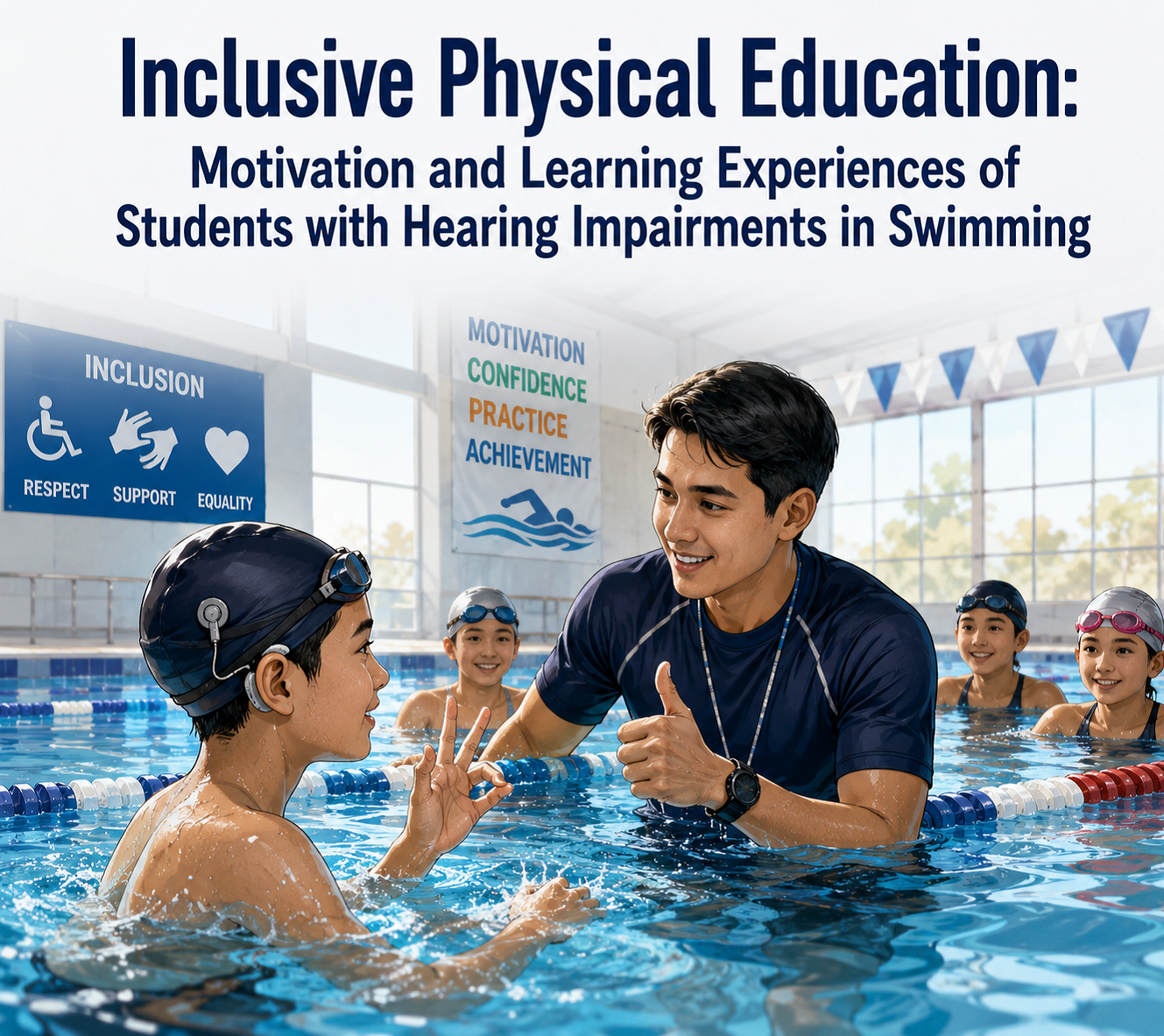
Inclusive Physical Education: Motivation and Learning Experiences of Students with Hearing Impairments in Swimming
Keywords:
Adaptive, Motivation, Learning Outcomes, Hearing-impaired, elementary school studentsAbstract
Background of study: Motivation plays a crucial role in determining students’ engagement and achievement in physical education, including in adaptive contexts for students with disabilities. However, empirical evidence examining the relationship between motivation and learning outcomes in swimming, particularly among hearing-impaired students, remains limited, especially within specialized educational settings.
Aims and scope of paper: This study aims to investigate the correlation between motivation and breaststroke swimming learning outcomes among hearing-impaired students at SLB Negeri Surakarta during the 2022/2023 academic year, as well as to determine the strength and significance of this relationship within an adaptive physical education context.
Methods: This research employed a quantitative approach with a simple correlational design. The study was conducted at SLB Negeri Surakarta, an accredited special needs school. Data were collected using validated instruments, with reliability confirmed by a coefficient ≥ 0.7. The relationship between variables was analyzed using the Kendall Tau-B correlation coefficient through SPSS software.
Results: The findings revealed a strong positive correlation between motivation and breaststroke swimming learning outcomes, indicated by a Kendall Tau-B coefficient of 0.657 and a significance value of 0.009 (p < 0.05). These results suggest that higher levels of motivation are significantly associated with better swimming performance among hearing-impaired students.
Conclusion: This study confirms that motivation is a key determinant of learning success in adaptive physical education. The findings support the integration of motivational strategies to enhance skill acquisition among students with hearing impairments. Therefore, educators are encouraged to apply structured motivational approaches, while policymakers should prioritize support for training and resources in inclusive physical education settings.
References
Adeduyigbe, A. M., Adeduyigbe, A. E., & Tijani, B. E. (2024). Addressing students with hearing impairment’s current state and future needs: Reforming an inclusive science education. International Journal of Studies in Inclusive Education, 1(2), 12–15.
Afifah, I. N., Setyawati, H., & Raharjo, A. (2025). Analysis of Anxiety, Stress, Self-Confidence, and Motivation of KU III Swimming Athletes in Achieving Goal Setting. Journal of Sport Science and Fitness, 11(2), 126–137. https://doi.org/10.15294/jssf.v11i2.34910
Alkasasbeh, W. J., Alawamleh, T., Aloran, H., Farash, T., & Orhan, B. E. (2024). The impact of mobile-assisted swimming applications on intrinsic motivation and fear reduction in aquatic environments among students in the swimming course. Frontiers in Sports and Active Living, 6, 1496733. https://doi.org/10.3389/fspor.2024.1496733
Bouarir, H., Diani, A., Boubker, O., & Rharzouz, J. (2023). Key determinants of women’s entrepreneurial intention and behavior: The role of business opportunity recognition and need for achievement. Administrative Sciences, 13(2), 33. https://doi.org/10.3390/admsci13020033
Ganesha, H. R., & Aithal, P. S. (2022). Choosing an appropriate data collection instrument and checking for the calibration, validity, and reliability of data collection instrument before collecting the data during Ph. D. program in India. International Journal of Management Technology and Social Sciences, 7(2), 497–513. https://doi.org/10.5281/zenodo.7310078
Ghafar, Z. (2023). The influence of self-confidence on English language learning: A systematic review. International Journal of Applied Educational Research (IJAER), 1(1), 55–68.
Hidayat, H., Komaini, A., & Gemaini, A. (2022). Smart Application for Smart Learning: How the Influence of the Factors on Student Swimming Learning Outcomes in Sports Education. International Journal of Interactive Mobile Technologies, 16(17). https://doi.org/10.3991/ijim.v16i17.34365
Huang, S., Hongseanyatham, P., & Siriphan, C. (2025). Construction of a Mobile Learning Model to Improve Breaststroke Swimming for University Students. International Journal of Sociologies and Anthropologies Science Reviews, 5(2), 477–486. https://doi.org/10.60027/ijsasr.2025.5666
Jariono, G., Nurhidayat, N., Sudarmanto, E., Nugroho, H., & Umar, F. (2025). The Impact of Adaptive Physical Education on the Physical and Cognitive Development of Children with Special Needs: A Literature Review. Physical Education Theory and Methodology, 25(3), 705–718. https://doi.org/10.17309/tmfv.2025.3.28
Liu, C.-C., Chiu, C. W., Chang, C.-H., & Lo, F. (2024). Analysis of a chatbot as a dialogic reading facilitator: its influence on learning interest and learner interactions. Educational Technology Research and Development, 72(4), 2103–2131. https://doi.org/10.1007/s11423-024-10370-0
Merdiaty, N., & Sulistiasih, S. (2024). Empowering Learning: The Mediating Role of Teachers in Enhancing Students’ Intrinsic Motivation. Al-Ishlah: Jurnal Pendidikan, 16(4), 5163–5172. https://doi.org/10.35445/alishlah.v16i4.6430
Roure, C., & Lentillon-Kaestner, V. (2022). Relationships between students’ individual interest, achievement goals, perceived competence and situational interest: A cluster analysis in swimming. European Physical Education Review, 28(2), 322–340. https://doi.org/10.1177/1356336X211045992
Sheffler, P., Rodriguez, T. M., Cheung, C. S., & Wu, R. (2022). Cognitive and metacognitive, motivational, and resource considerations for learning new skills across the lifespan. Wiley Interdisciplinary Reviews: Cognitive Science, 13(2), e1585. https://doi.org/10.1002/wcs.1585
Stoliarchuk, O., Serhieienkova, O., Khrypko, S., Prorok, N., Kalishchuk, S., Kolinko, M., & Binkivska, K. (2024). Self-development as a vector of sustainable development of society: the perspective of Ukrainian students. European Journal of Sustainable Development, 13(1), 428. https://doi.org/10.14207/ejsd.2024.v13n1p428
Downloads
Published
Issue
Section
License
Copyright (c) 2025 Khalil Junan Difa’

This work is licensed under a Creative Commons Attribution-ShareAlike 4.0 International License.
Spectapro: Journal of Cultural Currents in Physical Education and Sport Evolution



.png)