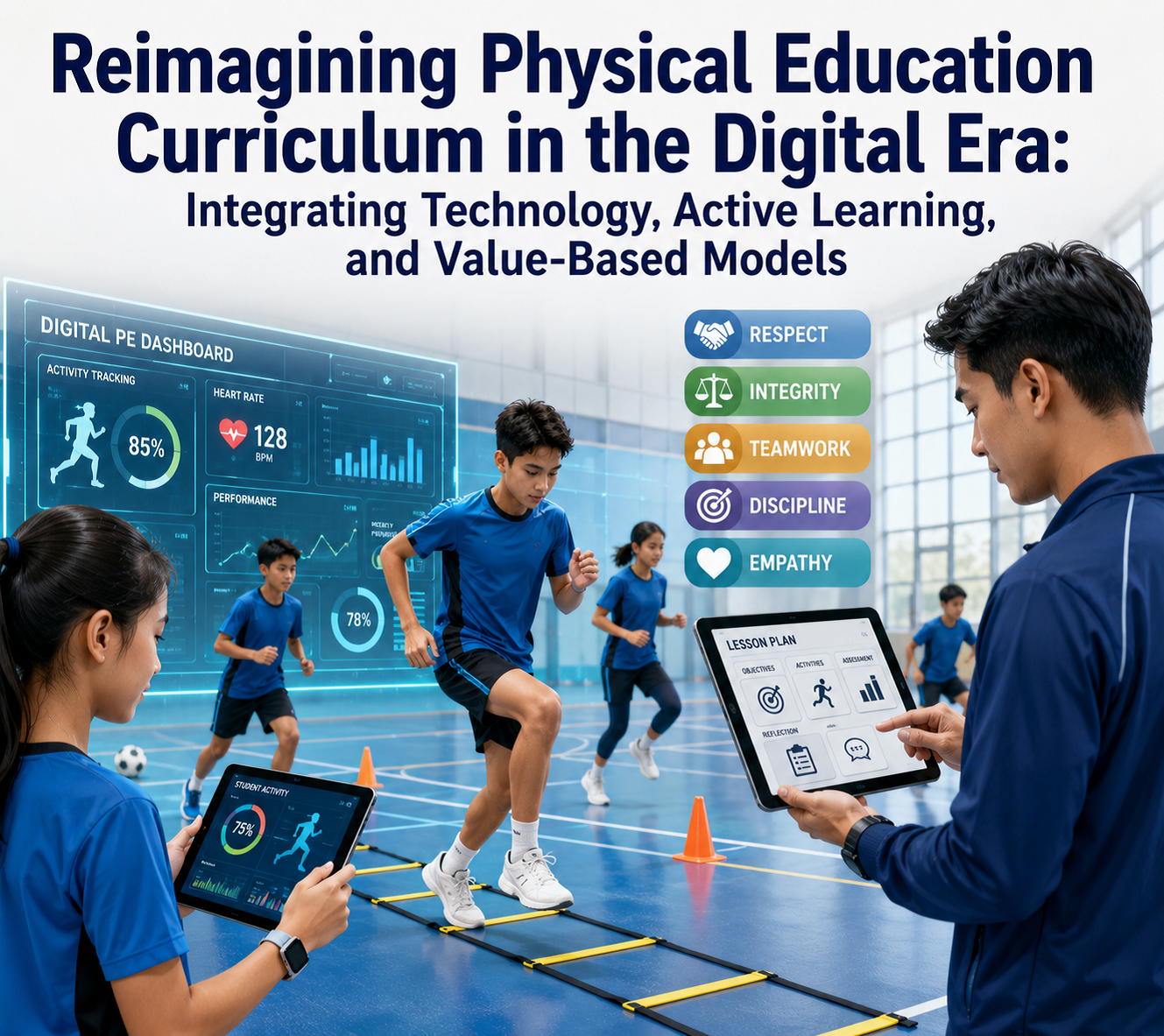
Reimagining Physical Education Curriculum in the Digital Era: Integrating Technology, Active Learning, and Value-Based Models
Keywords:
Akidah Model, Curriculum Development, Digital Literacy, Physical EducationAbstract
Background of study: Rapid digital developments demand a transformation in Physical Education (PE) curricula, especially at the primary level, where traditional approaches often fail to integrate digital literacy and character-based learning effectively.
Aims and scope of paper: This study aims to develop and evaluate a PE curriculum prototype for elementary schools in the digital era by integrating technology, active learning, and the AKIDAH model (Analytical, Creative, Islamic, Demonstrative, Active, Humanistic).
Methods: Using Design-Based Research (DBR), the study involved validation by 7 experts, implementation by 15 teachers, and field trials with 120 elementary students. Data were collected via expert validation sheets, observation rubrics, and student questionnaires, then analyzed using descriptive statistics and paired t-tests.
Results: The curriculum demonstrated strong validity (71.43% expert agreement) and significantly improved student engagement (+34%, p < 0.001), motor skills (+27%, p < 0.012), and digital literacy (+31%, p < 0.001).
Conclusion: The integration of digital tools and character-based models is effective in PE, aligning with constructivist learning theories and providing a validated prototype ready for digital-era elementary education.
References
Alencar, A. R. D., Castro, A. M., Soares, D. T. D., Amaral, L., & Gomes, R. L. R. (2024). Digitalization and participation in education: Opportunities, challenges, and initiatives in the digital world. IOSR Journal of Humanities and Social Science, 29(10), 18–26.
Di, Y., Li, Y., Cui, L., Yang, Z., Wang, H., & Zhou, T. (2025). Teaching scaffolding in physical education: A systematic review of the evolution from traditional methods to ai-enhanced approaches. Proceedings of the 2025 2nd International Conference on Artificial Intelligence and Future Education, 177–182. https://doi.org/10.1145/3785987.3786016
Feng, M. H., & Song, G. (2025). The Impact and Practice of Interdisciplinary Approaches on School Physical Education. International Journal of Education and Humanities, 5(4), 849–856. https://doi.org/10.58557/(ijeh).v5i4.353
Guo, S. (2025). Research on the Innovation of Art Education Teaching Models from a Multimodal Perspective. Journal of Modern Education and Culture, 2(4).
Hassan, G. (2023). Technology and the transformation of educational practices: A future perspective. International Journal of Economic, Business, Accounting, Agriculture Management and Sharia Administration (IJEBAS), 3(1), 1596–1603.
Herak, R. (2025). Character Education in the Digital Age: Challenges and Opportunities Amidst Technological Developments. MSJ: Majority Science Journal, 3(2), 245–252. https://doi.org/10.61942/msj.v3i2.367
Li, C., & Zhang, C. (2024). RETRACTED ARTICLE: Exploring the Current Landscape of Primary School Physical Education Within the Framework of the New Curriculum Reform: A Quality Evaluation Model Perspective. Journal of the Knowledge Economy, 15(4), 20677–20698. https://doi.org/10.1007/s13132-024-01873-5
Martín-Rodríguez, A., & Madrigal-Cerezo, R. (2025). Technology-enhanced pedagogy in physical education: Bridging engagement, learning, and lifelong activity. Education Sciences, 15(4), 409. https://doi.org/10.3390/educsci15040409
Mueller, J., & Wagner, I. (2026). Formative assessment of motor learning through digital tools in physical education: A systematic literature review. European Physical Education Review, 32(2), 383–403. https://doi.org/10.1177/1356336X251357207
Pellas, N. (2026). Effects of Augmented Reality-Enhanced Storytelling in Tertiary Philology Education. Journal of Educational Computing Research, 07356331261430158. https://doi.org/10.1177/07356331261430158
Soghomonyan, Z., & Karapetyan, A. (2023). Teaching strategies of the 21st century skills adapted to the local needs. European Journal of Teaching and Education, 5(3), 48–69.
Suresh Babu, S., & Dhakshina Moorthy, A. (2024). Application of artificial intelligence in adaptation of gamification in education: A literature review. Computer Applications in Engineering Education, 32(1), e22683. https://doi.org/10.1002/cae.22683
Tajik, O., Golzar, J., & Noor, S. (2025). Purposive sampling. International Journal of Education & Language Studies, 1–9. https://doi.org/10.22034/ijels.2025.490681.1029
Xu, B., Stephens, J. M., & Lee, K. (2024). Assessing student engagement in collaborative learning: development and validation of new measure in China. The Asia-Pacific Education Researcher, 33(2), 395–405. https://doi.org/10.1007/s40299-023-00737-x
Downloads
Published
Issue
Section
License
Copyright (c) 2025 Pungki Indarto, Gatot Jariono

This work is licensed under a Creative Commons Attribution-ShareAlike 4.0 International License.
Spectapro: Journal of Cultural Currents in Physical Education and Sport Evolution




.png)