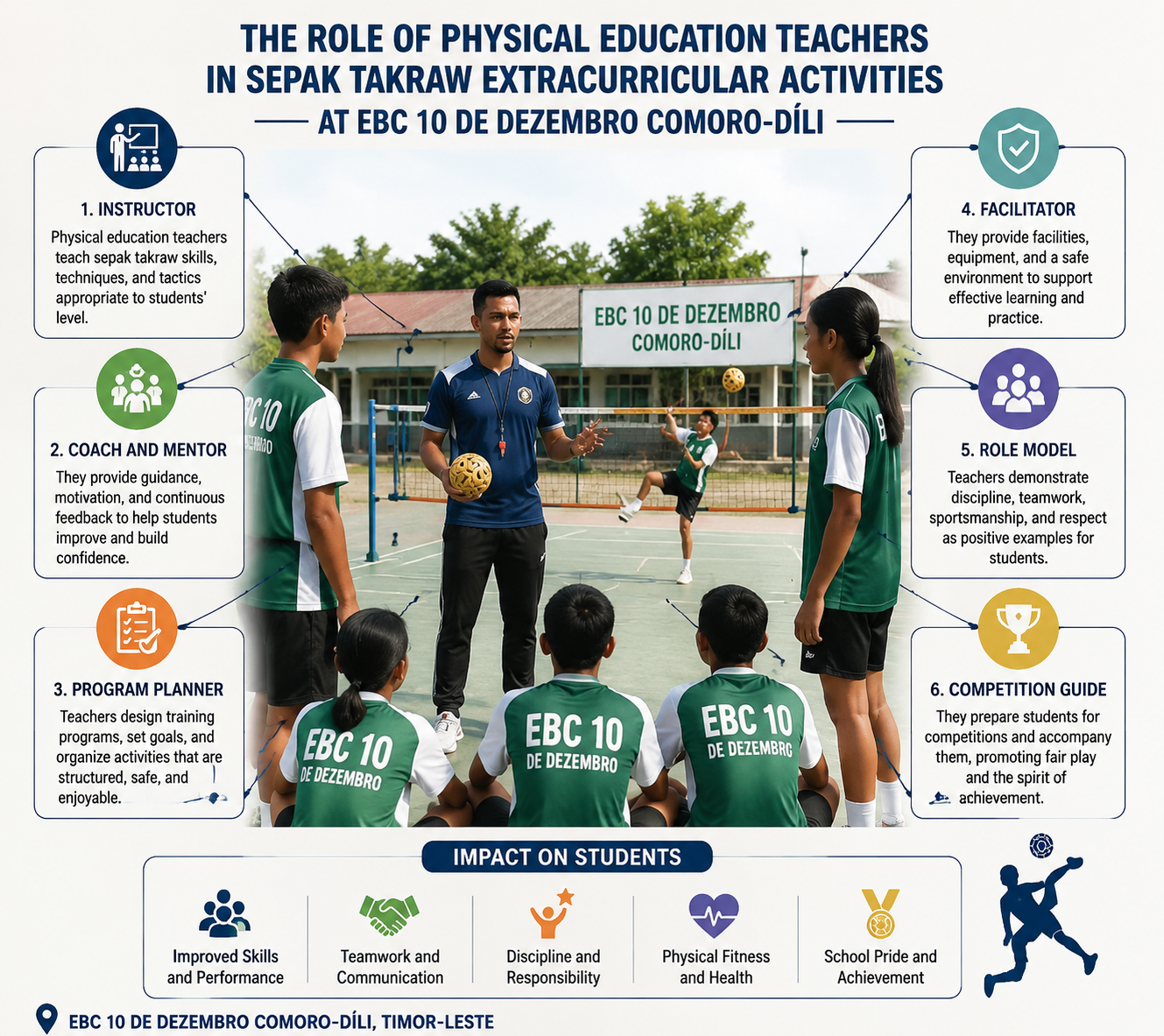
The Role of Physical Education Teachers in Sepak Takraw Extracurricular Activities at EBC 10 de Dezembro Comoro-Díli
Keywords:
Coach Role, Extracurricular, PE Teacher, Sepak Takraw, StudentAbstract
Background of study: Physical education is an integral part of the educational system aimed at developing students' physical, mental, social, and emotional capabilities. At EBC 10 Dezembro Comoro-Dili, Sepak Takraw extracurricular activities serve as a strategic platform for talent development; however, implementation still faces significant motivational and methodological challenges.
Aims and scope of paper: This study aims to analyze the role of Physical Education (PE) teachers in Sepak Takraw extracurricular activities at EBC 10 Dezembro Comoro-Dili and to identify the constraints and strategies involved in student coaching.
Methods: This study employed a descriptive method with a naturalistic qualitative approach (SRQR). Data were collected through observation, in-depth interviews with key informants (PE teachers/coaches and the school principal), and documentation. Data analysis followed the Miles and Huberman model: data reduction, data display, and conclusion drawing.
Results: The findings indicate that PE teachers play a vital role as planners, coaches, mentors, and motivators. While basic technical skills and discipline aspects are well-managed, significant constraints were found, including low student motivation, limited practice time, and a lack of variety in teaching methods. Institutional support in terms of policy is adequate, but the coaches' pedagogical innovation needs improvement.
Conclusion: The role of PE teachers at EBC 10 Dezembro Comoro-Dili is satisfactory in technical aspects but requires strengthening in innovation and motivational functions to ensure effective and sustainable coaching.
References
Anwar, C., Munir, M. S., Muharram, M. S., & Rozaq, M. M. N. (2025). Implementasi pembelajaran berdiferensiasi di sekolah dasar. Jurnal Ilmu Pendidikan Dasar Indonesia, 4(4), 213–229. https://doi.org/10.51574/judikdas.v4i4.3780
Baccari, S., Hadded, M., Ghazzai, H., Touati, H., & Elhadef, M. (2024). Anomaly detection in connected and autonomous vehicles: A survey, analysis, and research challenges. IEEE Access, 12, 19250–19276. https://doi.org/10.1109/ACCESS.2024.3361829
Cereda, F. (2023). A Modern Pedagogical Approach in The Subject of Physical Education. Physical Education and Sports: Studies and Research, 2(2), 126–141. https://doi.org/10.56003/pessr.v2i2.265
Hebard, S. P., Oakes, L. R., Davoren, A. K., Milroy, J. J., Redman, J., Ehrmann, J., & Wyrick, D. L. (2021). Transformational coaching and leadership: athletic administrators’ novel application of social and emotional competencies in high school sports. Journal of Research in Innovative Teaching & Learning, 14(3), 345–364. https://doi.org/10.1108/JRIT-01-2021-0006
Hernando-Garijo, A., Hortigüela-Alcalá, D., Sánchez-Miguel, P. A., & González-Víllora, S. (2021). Fundamental pedagogical aspects for the implementation of models-based practice in physical education. International Journal of Environmental Research and Public Health, 18(13), 7152. https://doi.org/10.3390/ijerph18137152
Kiram, Y., Sin, T. H., Azidin, R. M. F. R., & Denay, N. (2023). Evaluation of the sepak takraw training program in the Student Sports Education and Training Center (SSETC). Journal of Physical Education and Sport, 23(12), 3332–3340. https://doi.org/10.7752/jpes.2023.12381
Lindkvist, L. (2023). Navigating uncertainty: how do PE teachers respond to competing institutional pressures? European Journal for Sport and Society, 20(4), 383–399. https://doi.org/10.1080/16138171.2023.2182981
Mashoedi, M., Munif, M., & Suhermanto, S. (2025). Managing Character Education in Pluralistic Schools: A Model of Internalization of Interfaith Values. Journal of Educational Management Research, 4(2), 792–803. https://doi.org/10.61987/jemr.v4i2.1059
Mncube, D. W., Ajani, O. A., Ngema, T., & Mkhasibe, R. G. (2023). Exploring the problems of limited school resources in rural schools and curriculum management. UMT Education Review, 6(2), 1–31. https://doi.org/10.32350/UER.62.01
Mudzakir, M. F., Juliantine, T., Carsiwan, C., & Yulianto, A. G. (2025). An Analysis the Role of Extracurricular Sports in Building a Positive School Image. Journal of Educational Sciences, 9(2), 526–537. https://doi.org/10.31258/jes.9.2.p.526-537
Mustakim, I., Mawangir, M., Oviyanti, F., & Kurniawan, M. R. (2024). The internalization of religious cultural values in shaping the spiritual intelligence of students at SD Alam Palembang. Jurnal Cakrawala Pendas, 10(3), 596–661. https://doi.org/10.31949/jcp.v10i3.10098
Nunes, N. A., Kelly, A. L., McAuley, A. B. T., Neville, C., Braybrook, K., Comber, G., & Owers, L. (2024). Anthropometric and physical characteristics of youth soccer in Timor-Leste: A multi-dimensional analysis of male players in a developing country. Asian Exercise and Sport Science Journal, 8(1), 24–33.
Puspita, M., & Fitrisia, A. (2025). The Application of Character Values in Indonesian History: Contextual Approaches and Their Implementation to Strengthen Students’ Character. AL-ISHLAH: Jurnal Pendidikan, 17(2), 3548–3560. https://doi.org/10.35445/alishlah.v17i2.6748
Singh, A., & Parmar, V. S. (2023). Comprehensive approach to managing physical education and sports at all educational levels. Journal of Sports Science and Nutrition, 4(2), 258–263. https://doi.org/10.33545/27077012.2023.v4.i2d.233
Thorburn, M. (2021). Can physical education be meaningful: The role of embodied subjectivity in enhancing self and social learning? Curriculum Studies in Health and Physical Education, 12(1), 53–66. https://doi.org/10.1080/25742981.2020.1844028
Downloads
Published
Issue
Section
License
Copyright (c) 2025 Spectapro: Journal of Cultural Currents in Physical Education and Sport Evolution

This work is licensed under a Creative Commons Attribution-NonCommercial-ShareAlike 4.0 International License.
Spectapro: Journal of Cultural Currents in Physical Education and Sport Evolution




.png)