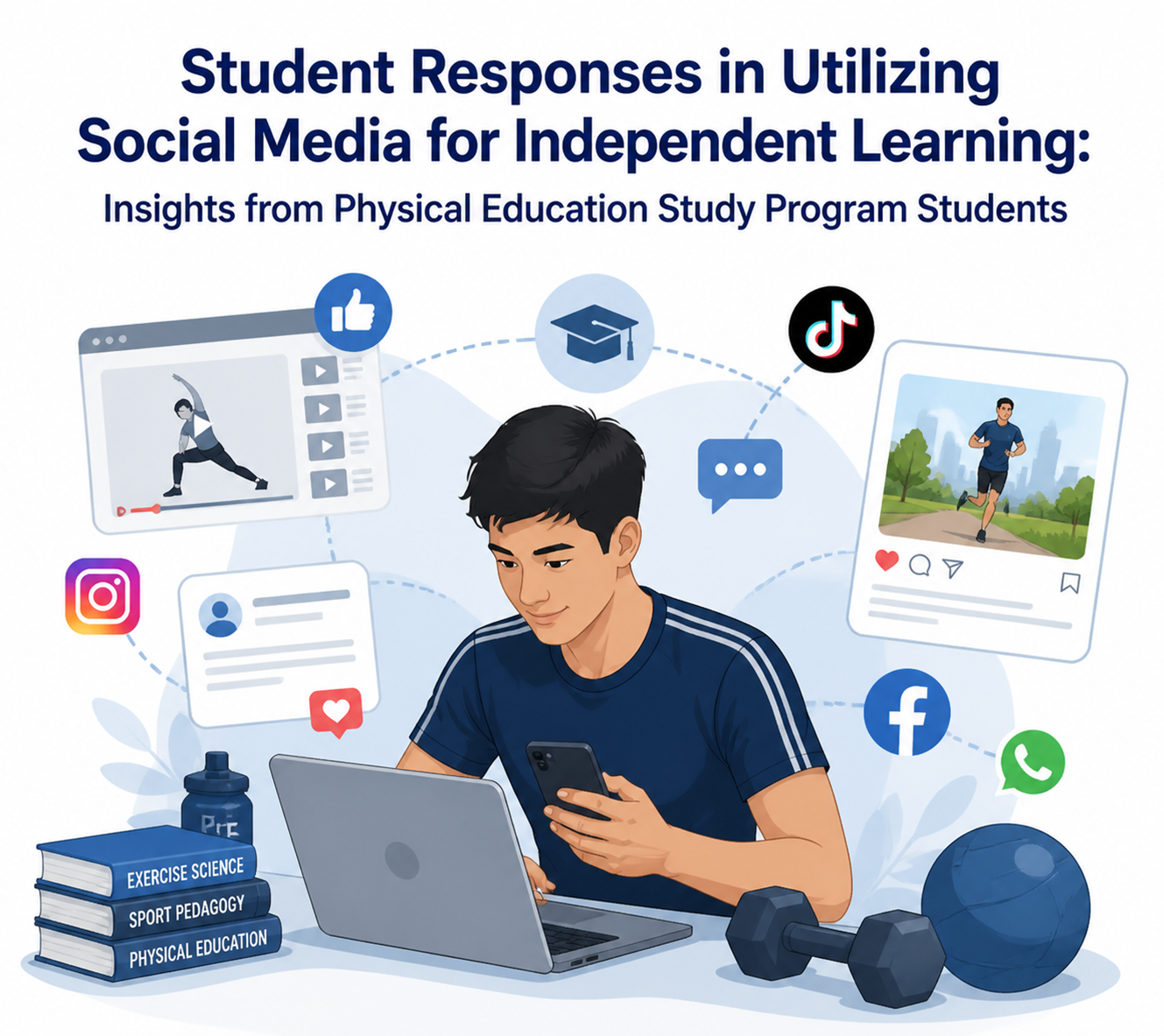
Student Responses in Utilizing Social Media for Independent Learning: Insights from Physical Education Study Program Students
Keywords:
Respons, Social Media, LearningAbstract
Background of study: Digital technology is now the main supporter of modern learning, with the internet and various digital media as popular learning resources that have great potential in increasing the effectiveness of the learning process.
Aims and scope of paper: This study aims to understand students' responses in using digital media as a learning resource and to examine its impact on improving their critical thinking skills towards social media.
Methods: This study uses a quantitative descriptive method with a survey approach and data analysis to describe the phenomena studied systematically. Data were collected using a questionnaire, then analyzed using descriptive statistical methods to describe the results systematically and structured.
Results: The results of the study show that social media is used by students as a source to find references related to lecture materials and references to work on assignments independently. Students said that social media as a source of independent learning has negative impacts, such as facilitating copy paste or plagiarism and causing laziness in thinking, which has the potential to weaken critical thinking skills. However, social media can also encourage critical skills by forcing students to choose accurate and reliable information.
Conclusion: The study shows that social media helps students find useful references, making it easier to understand materials and complete tasks. While it can lead to copy-pasting and reduced critical thinking, it also encourages students to choose reliable information, improving their analytical skills. The study highlights the need for students to use digital media effectively, critically assess information, and develop paraphrasing skills for better learning and critical thinking.
References
Arifudin, O. (2025). Why digital learning is the key to the future of education. International Journal of Education and Digital Learning (IJEDL), 3(4), 201–210. https://doi.org/10.47353/ijedl.v3i4.261
Astleitner, H., & Schlick, S. (2025). The social media use of college students : Exploring identity development , learning support , and parallel use. Active Learning in Higher Education. https://doi.org/10.1177/14697874241233605
Awoke, Y. A., & Zikargae, M. H. (2023). Exploring the opportunities and challenges of social media use in teaching and learning processes at public universities in Ethiopia. Cogent Education, 10(2), 2277558. https://doi.org/10.1080/2331186X.2023.2277558
Chang, S. L., & Kabilan, M. K. (2024). Using social media as e-Portfolios to support learning in higher education: a literature analysis. Journal of Computing in Higher Education, 36(1), 1–28. https://doi.org/10.1016/j.acalib.2021.102346
Herdiyanti, Y., Janah, M., & Susanto, R. (2025). Building a Golden Generation: Synergy of Education, Technology, and Qur’anic Values. JISEI: Journal of Islamic Studies and Educational Innovation, 1(1), 36–45. https://doi.org/10.61094/jisei.v1i1.49
Huda, M. (2024). Between accessibility and adaptability of digital platform: investigating learners’ perspectives on digital learning infrastructure. Higher Education, Skills and Work-Based Learning, 14(1), 1–21. https://doi.org/10.1108/HESWBL-03-2022-0069
Khatri, D. (2021). Use of social media information sources: a systematic literature review. Online Information Review, 45(6), 1039–1063. https://doi.org/10.1108/OIR-04-2020-0152
Kirschner, J. (2024). The newest generational divide: Social media influence on digital natives. Visual Communication Quarterly, 31(3), 199–205. https://doi.org/10.1080/15551393.2024.2396791
Layoo, N., Raheni, C., Djawa, S. K., Rajindra, R., & Anggraeni, R. N. (2025). Demographic Characteristics and Entrepreneurial Inclination of University Student. International Journal of Health, Economics, and Social Sciences (IJHESS), 7(1), 1–9. https://doi.org/10.56338/ijhess.v7i1.6372
Nyoman, N., & Putu, S. (2020). Efektivitas Penggunaan E-Learning dalam Pengajaran di Kelas untuk Meningkatkan Kemampuan Berpikir Kritis Mahasiswa. Jurnal Ilmiah IKIP Mataram (JIIM), 7(2).
Sinaga, P., & Setiawan, W. (2022). The impact of electronic interactive teaching materials (EITMs) in e-learning on junior high school students’ critical thinking skills. Thinking Skills and Creativity, 46, 101066. https://doi.org/10.1016/j.tsc.2022.101066
Szymkowiak, A., Melović, B., Dabić, M., Jeganathan, K., & Kundi, G. S. (2021). Information technology and Gen Z: The role of teachers, the internet, and technology in the education of young people. Technology in Society, 65, 101565. https://doi.org/10.1016/j.techsoc.2021.101565
Theophilou, E., Hernández‐Leo, D., & Gómez, V. (2024). Gender‐based learning and behavioural differences in an educational social media platform. Journal of Computer Assisted Learning, 40(6), 2544–2557. https://doi.org/10.1111/jcal.12927
Wang, C., Yuan, Y., & Ji, X. (2024). Effects of blended learning in physical education on university students’ exercise attitudes and basketball skills: a cluster randomized controlled trial. BMC Public Health, 24(1), 3170.
Yadav, N. (2024). The impact of digital learning on education. International Journal of Multidisciplinary Research in Arts, Science and Technology, 2(1), 24–34. https://doi.org/10.61778/ijmrast.v2i1.34
Downloads
Published
Issue
Section
License
Copyright (c) 2025 Imron Nugroho Saputro, Amanda Eka Rismawati

This work is licensed under a Creative Commons Attribution-ShareAlike 4.0 International License.
Spectapro: Journal of Cultural Currents in Physical Education and Sport Evolution



.png)