Nafāqah as an Islamic Social Security Mechanism: Theoretical and Empirical Gaps in the Eastern Province of Sri Lanka
DOI:
https://doi.org/10.59698/quru.v4i2.593Keywords:
Nafāqah, Eastern Sri Lanka, Quazi courts, Fiqh, Maintenance, Islamic Social Security, Muslim WomenAbstract
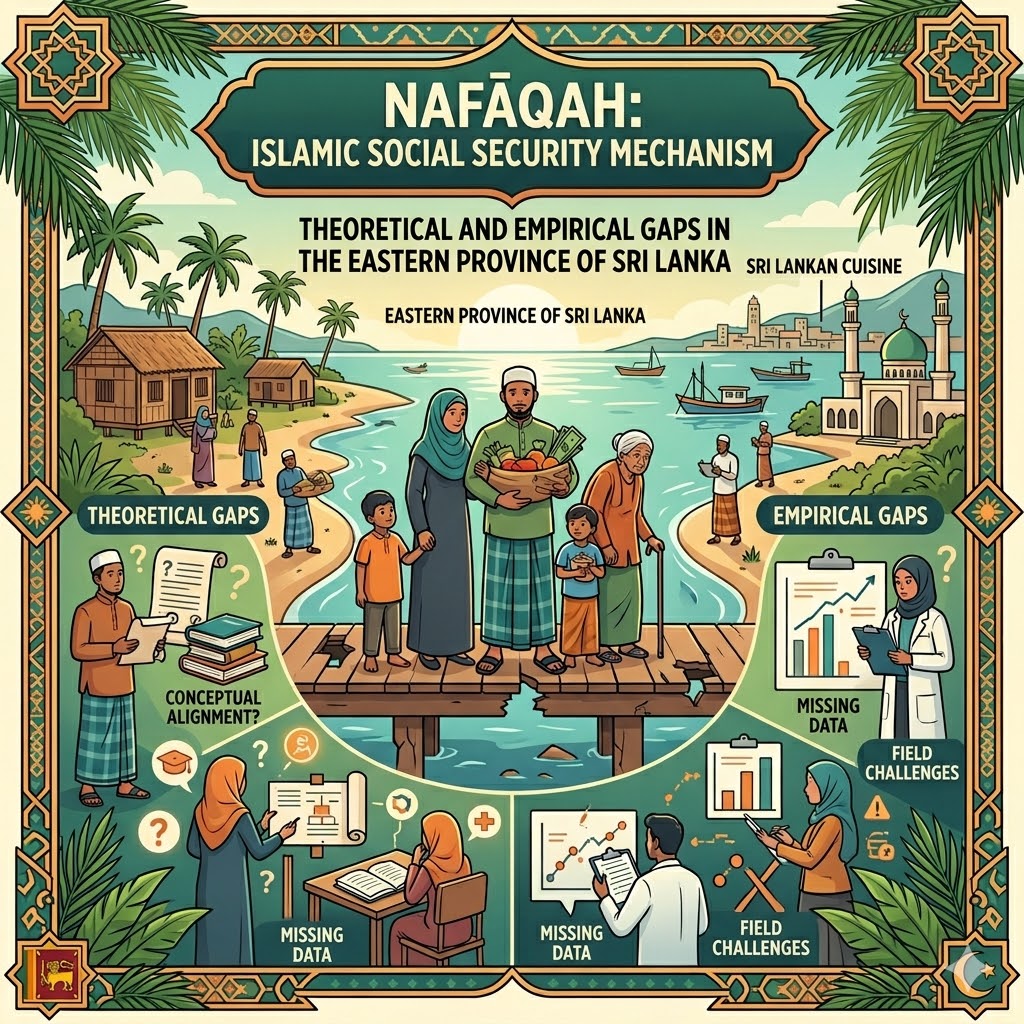
Nafāqah, the husband's obligation to provide maintenance to his wife in Islamic law, is a crucial social security mechanism in Islam's socio-economic system. Despite being regulated in classical texts, its implementation often faces significant gaps, especially in countries with Muslim minority populations. In the Eastern Province of Sri Lanka, nafāqah under the Muslim Marriage and Divorce Act No. 13 of 1951 (MMDA) shows institutional failure, influenced by post-conflict issues, the kudi system, and women’s economic roles. This article identifies gaps in nafāqah implementation in Sri Lanka, focusing on the failures of existing laws and the factors behind them. It proposes a conceptual framework for further research on nafāqah in this context. A systematic review of classical fiqh sources, comparative legal studies, and gray literature from Sri Lankan advocacy organizations reveals five key research gaps: lack of primary data, inadequate theoretical frameworks, unexplained relationships between women's employment and nafāqah, the kudi system’s impact on housing obligations, and the dominance of qualitative methods. The study highlights that institutional failures in implementing nafāqah in Eastern Sri Lanka are underexplored. The lack of primary data and inadequate theoretical frameworks hinder a deeper understanding of nafāqah practices. Further empirical research is essential to strengthen evidence regarding nafāqah’s role in fulfilling the rights of Muslim women. This article contributes by proposing a conceptual framework integrating Islamic fiqh and social science approaches and identifying data gaps that need further investigation. It also offers policy recommendations to support effective reforms of the MMDA to protect Muslim women’s rights in Sri Lanka.
References
Abdoeh, Nor Mohammad, Perbandingan Hukum Keluarga Di Dunia Muslim (Benua Asia, Afrika, Dan Eropa), 1st ed. (Kab. Semarang: The Mahfud Ridwan Institute, 2022).
Al-Bahuti, Muhammad. (1982). Kashf Al-Qina' 'An Matn Al-Iqna' (Vol. 5). Dar Al-Fikr.
Al-Dasuqi, Muhammad. (1998). Hashiyat Al-Dasuqi 'Ala Al-Sharh Al-Kabir (Vol. 2). Dar Al-Fikr.
Al-Nawawi, Yahya. (1991). Al-Majmu' Sharh Al-Muhadhdhab (Vol. 18). Dar Al-Fikr.
Al-Tarira, Abdurrahman. (2022). Women's Economic Rights and Islamic Law: A Contemporary Reassessment. Journal of Islamic Studies, 18(1), 33–57.
Al-Zuhaili, Wahbah. (1984). Al-Fiqh Al-Islami Wa Adillatuhu (Vol. 7). Dar Al-Fikr.
Ali, Muhammad, & Fozia, Mariam. (2021). Social Security for Women in Islam: Mechanisms And Contemporary Applications. Journal of Islamic Law and Society, 14(3), 45–68.
Al-Bukhari, Muhammad. (1422H). Sahih Al-Bukhari, Kitab Al-Nafaqat (Hadith No. 5364). Dar Tawq Al-Najah.
Bhat, Aijaz Raza. (2024). Nafāqah as an Islamic Welfare Mechanism: Classical Doctrine And Modern Challenges. International Journal of Islamic Law, 5(1), 12–30.
Braun, Virginia, & Clarke, Victoria. (2006). Using Thematic Analysis in Psychology. Qualitative Research In Psychology, 3(2), 77–101. https://doi.org/10.1191/1478088706qp063oa
Fatima Z. Rahman, Cambridge University Press. (2025). Islamic Doctrine and Women's Economic Rights: Implications Of An Ambiguous Relationship For State Policy In The Muslim World. Politics and Religion. https://doi.org/10.1017/S175504832500001X
Colombo Telegraph. (2017, March 8). MMDA Maintenance Provisions: What Do They Really Offer Muslim Women? https://www.colombotelegraph.com
Creswell, John W., & Plano Clark, Vicki L. (2017). Designing and Conducting Mixed Methods Research (3rd Ed.). SAGE Publications.
Dawood, Mohamed. (2024a). the Politics of Muslim Personal Law Reform In Sri Lanka. South Asian Law Review, 9(1), 22–38.
Dawood, Mohamed. (2024b). MMDA Reform and Muslim Women's Rights in Sri Lanka: Progress and Obstacles. Sri Lanka Law Review, 15(2), 45–60.
Farque, Mohammad Omar. (2025). Muslim Wife's Right To Maintenance In Bangladesh: Analysed Through The Lenses of Shari'ah and Judicial Decisions. Legal Transformation in Muslim Societies, 1(3), 59–84. https://doi.org/10.2139/ssrn.5113239
Ferdaus, Jannatul. (2017). Rights of Maintenance of A Muslim Wife Under Islamic Law: A Legal Analysis. Bangladesh Journal of Integrated Thoughts, 13(20), 23–36.
Goonesekere, Shyamala. (1990). Women's Rights and Personal Law in Sri Lanka. Centre for Women's Research.
Groundviews. (2024, December 13). Muslim Marriage and Divorce Act: Reform is Not Repeal. https://groundviews.org/2024/12/13/muslim-marriage-and-divorce-act-reform-is-not-repeal/
Hayes, Andrew F. (2017). Introduction to Mediation, Moderation, and Conditional Process Analysis (2nd Ed.). Guilford Press.
Hjabubakar, Muhammad. (2010). Nafāqah in Classical Islamic Jurisprudence: A Comparative Analysis of the Four Schools. Journal of Muslim Family Studies, 4(1), 33–50.
Ibn Hajr Al-Asqalani, Ahmad. (2002). Fath Al-Bari: Sharh Sahih Al-Bukhari (Vol. 9). Dar Al-Kutub Al-Ilmiyya.
Ibrahim, Muthia, Saujan, M. H. M., & Mazahir, M. S. M. (2022). Muslim Women's Economic Participation in Post-Conflict Eastern Sri Lanka. Journal of South Asian Studies, 11(2), 78–95.
IMF. (2023). Sri Lanka: Post-Conflict Reconstruction and Economic Recovery. International Monetary Fund.
Kabeer, Naila. (1999). Resources, Agency, Achievements: Reflections On The Measurement Of Women's Empowerment. Development and Change, 30(3), 435–464. https://doi.org/10.1111/1467-7660.00125
Karimullah, Sulaiman, et al. (2024). Nafāqah and Women's Welfare in Malaysian Islamic Courts: An Empirical Assessment. Asian Journal of Comparative Family Law, 6(1), 44–63.
Krejcie, Robert V., & Morgan, Daryl W. (1970). Determining Sample Size for Research Activities. Educational And Psychological Measurement, 30(3), 607–610. https://doi.org/10.1177/001316447003000308
Maimun, Mohammad, et al. (2024). The Concept of Nafāqah in Islamic Law And Women's Perspectives. El-Izdiwaj: Indonesian Journal of Civil and Islamic Family Law, 5(2), 1–18.
Mir-Hosseini, Ziba. (2009). Towards Gender Equality: Muslim Family Laws and the Shari'ah. In Z. Anwar (Ed.), Wanted: Equality and Justice In The Muslim Family (pp. 23–63). Musawah.
Mohd, Abdul, & Hj Ibrahim, Haji. (2012). Nafāqah in Contemporary Islamic Family Law: A Comparative Analysis. International Journal of Islamic Law and Society, 5(2), 23–44.
MPLRAG. (2021). Report of the Muslim Personal Law Reform Action Group. MPLRAG Secretariat.
MPLRAG. (2023, July 15). Statement: Muslim MPs Betray MMDA Reforms — Justice For Sri Lankan Muslim Women Under Threat. https://www.mmdasrilanka.org
MPLRAG. (2026, January). Statement: MPLRAG's Response to MP Faiszer Musthapha's Private Members Bill — Piecemeal MMDA Reform Fails Muslim Women. https://www.mmdasrilanka.org
Muhammad, Nasir. (2022). Enforcement of Maintenance Orders In Syariah Courts: Evidence from Malaysia. Journal of Islamic Family Law, 9(1), 45–64.
Munir, Muhammad. (2023). the Maintenance Rights Of Muslim Women: A Juristic and Comparative Analysis. Pakistan Journal of Islamic Law, 12(1), 23–41.
Nasir, Jamil, & Shamsuddin, Jamil. (2024). Nafāqah Past and Present: Doctrinal Evolution and Applied Challenges In Islamic Family Law. Journal of Comparative Family Law, 11(2), 33–58.
Nisthar, Mohammed, et al. (2017). Economic Vulnerability of Muslim Women Following Marital Dissolution in Eastern Sri Lanka. Eastern University Research Journal, 8(1), 45–62.
Osuly, Abdul, Safi, Mohammad, & Ayubi, Hasan. (2024). Definition, Scope, and Application of Nafāqah In Islamic Jurisprudence. Journal of Islamic Jurisprudence, 7(1), 15–34.
Sameem, Mohammad Ahsan, et al. (2025). Nafāqah of A Wife In Islam: The Concept Of Maintenance In Islamic Jurisprudence. Cognizance Journal of Multidisciplinary Studies, 5(4), 912–933.
Saujan, M. H. M., & Mazahir, M. S. M. (2021). Islamic Social Welfare Mechanisms In Sri Lanka: An Overview. Journal of Muslim Social Sciences, 5(1), 22–40.
Sen, Amartya. (1990). Gender and Cooperative Conflicts. In I. Tinker (Ed.), Persistent Inequalities (pp. 123–149). Oxford University Press.
Sezgin, Yasir, & Casanova, Juan. (2024). Transforming "Transformative Accommodation": Palestinian-Muslim Women's Maintenance Suits As A Case Study. Law & Social Inquiry, 49(4), 2102–2127. https://doi.org/10.1017/lsi.2023.64
Shakor, Masha, & Muda, Mohd. (2023). the Components And Quantum Of Nafāqah In Islamic Law: Classical And Contemporary Perspectives. Journal Of Islamic Law And Contemporary Society, 10(1), 22–44.
Siyana, Ibrahim, Mohamed Haniffa, Farhana, & Saujan, M. H. M. (2023). The Maternal Role And Social Obligations Of Muslim Women In Eastern Sri Lanka. Eastern University Journal, 10(2), 56–72.
Syarie, Abdul. (2019). Nafāqah: Legal Basis, Doctrinal Parameters, and Contemporary Practice. Journal of Islamic Family Law, 8(2), 44–62.
The Diplomat. (2025, May 16). "And With Every Hardship." Sri Lankan Women Continue To Push For Muslim Marriage Law Reform. https://thediplomat.com/2025/05/and-with-every-hardship-sri-lankan-women-continue-to-push-for-muslim-marriage-law-reform/
Tucker, Judith. (2008). Women, Family, and Gender In Islamic Law. Cambridge University Press.
Ustaoğlu, Mehmet. (2023). Nafaqa. In The Palgrave Encyclopedia Of Islamic Finance And Economics (pp. 1–5). Springer. https://doi.org/10.1007/978-3-030-93703-4_350-1
Vidhi Judicial Academy. (2024). Mohd. Abdul Samad V. State Of Telangana & Anr. (2024): Maintenance under Muslim Law. http://vidhijudicial.com
Wadud, Amina. (1999). Quran and Woman: Rereading the Sacred Text From A Woman's Perspective. Oxford University Press.
World Bank. (2022). Sri Lanka Development Update: Addressing the Economic Crisis. World Bank Group.
Yasin, Mohammad, et al. (2024). Financial Obligations of the Husband In Islamic Law: A Jurisprudential Review. International Journal of Islamic Studies, 11(1), 15–35.
Yilmaz, Ibrahim. (2015). Muslim Laws, Politics and Society in Modern Nation States. Ashgate Publishing.
Yusuf Al-Qaradawi. (2005). the Lawful And The Prohibited In Islam (2nd Ed.). Al-Falah Foundation.
Downloads
Published
How to Cite
Issue
Section
License
Copyright (c) 2026 Saujan Iqbal, MIM. Jazeel, Yusuf Sani Abubakar

This work is licensed under a Creative Commons Attribution-NonCommercial-ShareAlike 4.0 International License.
Quru': Journal of Family Law and Culture




.png)