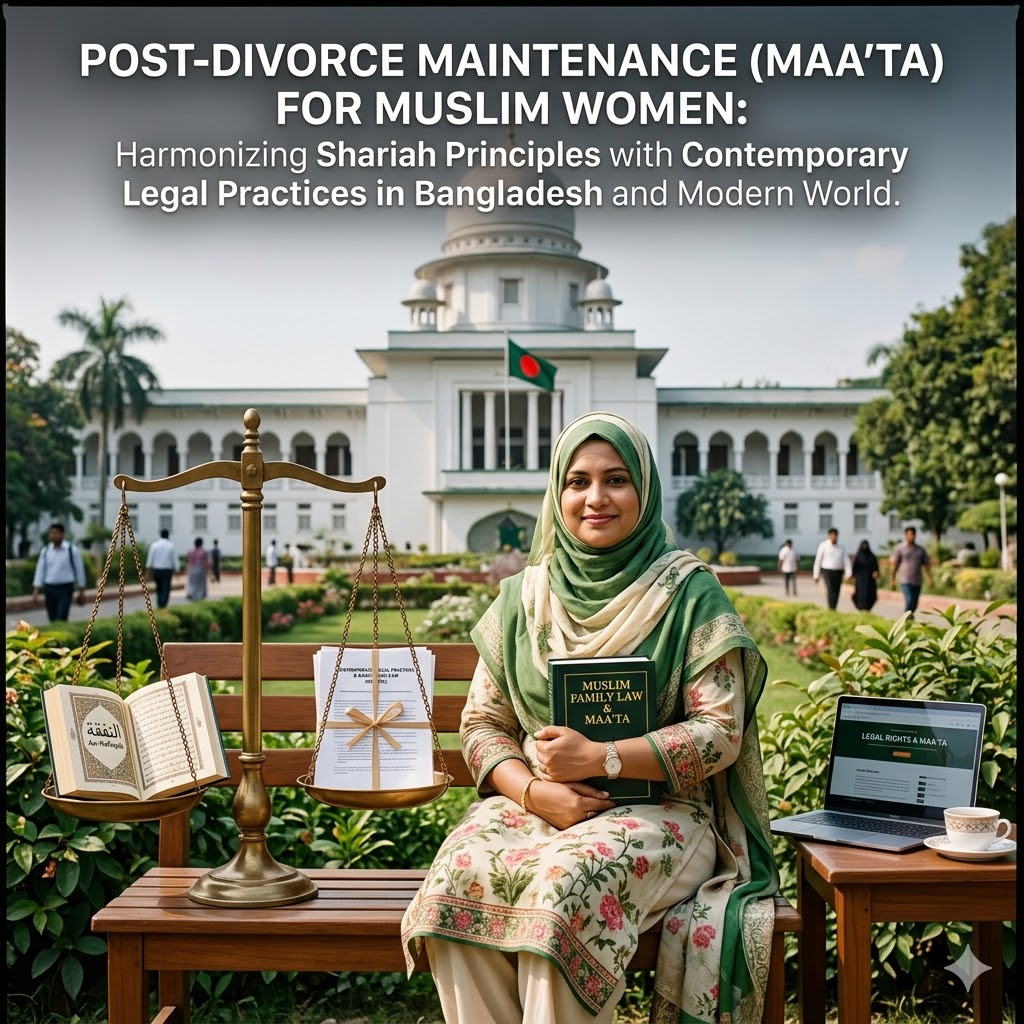
The Post-Divorce Maintenance (Maa’ta) for Muslim Women: Harmonizing Shariah Principles with Contemporary Legal Practices in Bangladesh and Modern World
DOI:
https://doi.org/10.59698/quru.v4i2.588Keywords:
Maintenance, Post-Divorce, Maa’ta, Shariah Law, Muslim Women, Modern WorldAbstract
Post-divorce maintenance (Maa’ta) for women in Islamic law is often a controversial topic, particularly regarding the interpretation and application of laws that vary across different countries. In Bangladesh, despite the Muslim-majority population, the legal framework governing women's post-divorce rights, specifically related to maintenance or maa'ta, remains unclear and has not been formally regulated. This study aims to analyze the application of Islamic law regarding post-divorce maintenance in Bangladesh's religious courts, as well as to explore the challenges faced by women in this context. The methodology used is a qualitative approach with a case study design, where data is collected through semi-structured interviews with judges, lawyers, and Islamic law experts, as well as observations of the judicial process in religious courts. In addition, documentation related to court decisions and legal regulations is also analyzed. The findings indicate that, although Islamic law recognizes women's right to post-divorce maintenance, its implementation in Bangladesh remains limited and uneven, with some cases not receiving any maintenance after the iddah period. This study contributes by identifying legal gaps and highlighting the need for reform to protect women's rights to post-divorce maintenance, while also providing insights for the development of a more responsive Islamic legal policy in Bangladesh to meet evolving social needs.
References
Abdoeh, Nor Mohammad, Perbandingan Hukum Keluarga Di Dunia Muslim (Benua Asia, Afrika, Dan Eropa), 1st ed. (Kab. Semarang: The Mahfud Ridwan Institute, 2022).
Abdullah, Raihanah, and others. (2015). Financial Support for Women under Islamic Family Law in Bangladesh and Malaysia. Asian Journal of Women’s Studies, 21(3), 363-376. https://doi.org/10.1080/12259276.2015.1106853
Abiad, Nisrine. (2008). Sharia, Muslim States and International Human Rights Treaty Obligations: A Comparative Study. BIICL. https://books.google.com/books?id=dex7TKuoUhgC
Anil E and others, ‘Turkish Civil and Penal Code Reforms From a Gender Perspective: The Success of Two Nationwide Campaigns’ accessed 23 February 2026
Anıl E and others, ‘THE NEW LEGAL STATUS OF WOMEN IN TURKEY Written By’ Azharul Islam M and Nahar A, ‘Rethinking the Plights of Divorcee under Islamic Family Law’ (2011) 22 Dhaka University Law Journal
Souaiaia, Ahmed. (2005). On the Sources of Islamic Law and Practices. Journal of Law and Religion, 20, 123. https://www.cambridge.org/core/journals/journal-of-law-and-religion/article/abs/on-the-sources-of-islamic-law-and-practices/87274CD4999552C666DABFA12E108F60
Baillie, Neil Benjamin Edmonstone. (1865). A Digest of Moohummudan Law on the Subjects to Which It Is Usually Applied by British Courts of Justice in India. Smith, Elder, and Co. https://books.google.com.bd/books?hl=en&lr=&id=NoZEAQAAMAAJ&oi=fnd&pg=PR8&dq=Neil+B.+E.+Baillie&ots=J5KkVQi_MO&sig=sM3iiu9T2jFrZWBGPEiEuBX7XpY
Balchin C, ‘Family Law in Contemporary Muslim Contexts: Triggers and Strategies for Change’ Wanted: Equality and Justice in the Muslim Family Law 209 <https://arabic.musawah.org/sites/default/files/Family%20law%20in%20contemporary%20Muslim%20Context.pdf> accessed 25 December 2025
Brodsky, Alexander E., Buckingham, Susan L., Scheibler, Jessica E., and Mannarini, Tiziana. (2016). Introduction to qualitative approaches. In Handbook of Methodological Approaches to Community-Based Research: Qualitative, Quantitative, and Mixed Methods (pp. 13-22).
Coulson, Noel J. (1971). A History of Islamic Law. Tylor & Francis Group. http://islam-and-muslims.com/Coulson-History-Islamic-Law.pdf
Esposito, John L. (2001). Women in Muslim Family Law (2nd ed.). Syracuse University Press. https://press.syr.edu/supressbooks/1231/women-in-muslim-family-law-2nd-edition/
Faustina Pereira, ‘Post Divorce Maintenance for Muslim Women and the Islamist Discourse’ in Harsh Kapoor (ed), Women Living Under Muslim Laws (Dossier 22 1991) <https://www.wluml.org/wp-content/uploads/2003/07/D22.pdf?> accessed 23 February 2026
Fyzee, Asaf Ali Asgher. (1965). Outlines of Muhammadan Law (3rd ed.). Oxford University Press. https://law.nus.edu.sg/sjls/wp-content/uploads/sites/14/2024/07/393-1965-7-mal-jul-242.pdf
Hamilton, Charles. (1982). The Hedaya, or Guide: A Commentary on the Mussulman Laws (2nd ed.). Premier Book House.
Ilyas, Muhammad Azizzullah. (2019). Islam Dalam Demokrasi Bangladesh. Fokus: Jurnal Kajian Keislaman Dan Kemasyarakatan, 4(1), 48-66.
Islam, Mohammad Azharul, and Nahar, Azizun. (2011). Rethinking the Plights of Divorcee under Islamic Family Law. Dhaka University Law Journal, 22, 93-112. https://www.researchgate.net/profile/Mohammad-Islam-412/publication/365195397_Rethinking_the_Plights_of_Divorcee_under_Islamic_Family_Law/links/6369ed272f4bca7fd03e7a87/Rethinking-the-Plights-of-Divorcee-under-Islamic-Family-Law.pdf
Jamal J. Ahmad Nasir, The Status of Women under Islamic Law and Modern Islamic Legislation, vol 1 (H.H. Prof. Eugene Cotran, Mark Hoyle and Martin Lau eds, 3rd ed, Brill 2009) <https://ijtihadnet.com/wp-content/uploads/The-Status-of-Women-under-Islamic-Law-and-Modern-Islamic-Legislation.pdf> accessed 23 February 2026
Tusi, Mohammad. (2008). Concise Description of Islamic Law and Legal Opinions. ICAS Press.
Munir M and https://iiui.academia.edu/DrMuhammadMunir, ‘Stipulations in a Muslim Marriage Contract with Special Reference to Talaq Al-Tafwid Provisions in Pakistan’ (2005) 12 Yearbook of Islamic and Middle Eastern Law Online 235 <https://doi.org/10.1163/22112987-91000133> accessed 23 February 2026
Nasir, Jamal J. Ahmad. (2009). The Status of Women under Islamic Law and Modern Islamic Legislation (Vol. 1). H.H. Prof. Eugene Cotran, Mark Hoyle & Martin Lau (Eds.), Brill. https://ijtihadnet.com/wp-content/uploads/The-Status-of-Women-under-Islamic-Law-and-Modern-Islamic-Legislation.pdf
Pereira, Dr. Faustina. (1991). Post Divorce Maintenance for Muslim Women and the Islamist Discourse. In H. Kapoor (Ed.), Women Living Under Muslim Laws (Dossier 22). https://www.wluml.org/wp-content/uploads/2003/07/D22.pdf?
Rehman F, ‘Post-Divorce Maintenance for Muslim Women in Pakistan and India’ (1998) 2 Bangladesh Journal of Law 26 <https://biliabd.org/wp-content/uploads/2021/08/Fayyazur-Rahman.pdf> accessed 15 December 2025
Rehman F-, ‘Islamic Law Of Maintenance For Wives In Pakistan And Afghanistan Since 1960’ (University of Peshawar 2004) accessed 23 February 2026
Serajuddin Muhammad, Muslim Family Law, Secular Courts and Muslim Women of South Asia : A Study in Judicial Activism (Oxford University Press 2004) <https://lawcat.berkeley.edu/record/451553> accessed 23 February 2026
Shahid, Ayesha. (2010). For the Sake of Justice: Protecting Divorced Women’s Rights in Pakistan by Re-Examining the Sharia Principle of Mutat (Post-Divorce Maintenance). Journal of Islamic State Practice in International Law, 6(1), 40-50. https://pureportal.coventry.ac.uk/en/publications/for-the-sake-of-justice-protecting-divorced-womens-rights-in-paki/
Shahid, Ayesha. (2013). Post-Divorce Maintenance for Muslim Women in Pakistan and Bangladesh: A Comparative Perspective. International Journal of Law, Policy, and the Family, 27(2), 197-215. https://doi.org/10.1093/lawfam/ebt004
Souaiaia A, ‘On the Sources of Islamic Law and Practices’ (2005) 20 Journal of Law and Religion 123 <https://doi.org/10.2307/4144685> accessed 15 December 2025
Tusi, Mohammad. (2008). Concise Description of Islamic Law and Legal Opinions. ICAS Press.
Zulficar, Mona. (2008). The Islamic Marriage Contract in Egypt. In A. Quraishi & F. E. Vogel (Eds.), The Islamic Marriage Contract: Case Studies in Islamic Family Law. Harvard University Press. https://api.law.wisc.edu/repository-pdf/uwlaw-library-repository-omekav3/original/3b10f69a03d4e6d5bff6d121f8ab36aee3a29baf.pdf
The Limitation Act, 1908
Turkish Civil Code
Downloads
Published
How to Cite
Issue
Section
License
Copyright (c) 2026 Syeda Afroza Zerin, Asaduszaman Sohag, Md. Niamur Raquib

This work is licensed under a Creative Commons Attribution-NonCommercial-ShareAlike 4.0 International License.
Quru': Journal of Family Law and Culture




.png)