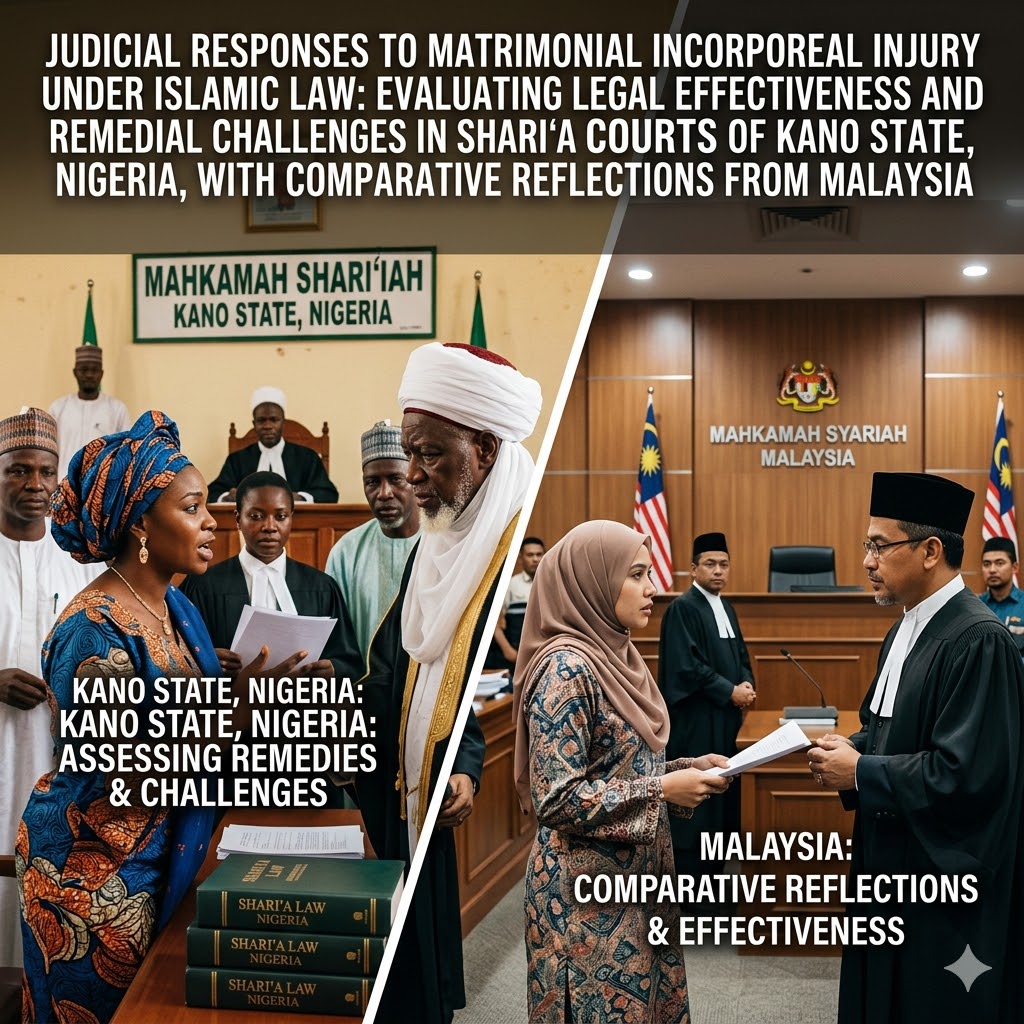
Judicial Responses to Matrimonial Incorporeal Injury under Islamic Law: Evaluating Legal Effectiveness and Remedial Challenges in Shariʿa Courts of Kano State, Nigeria, with Comparative Reflections from Malaysia
DOI:
https://doi.org/10.59698/quru.v4i2.585Keywords:
Matrimonial Incorporeal Darar, Islamic Family Law, Judicial Remedies, Evidentiary Challenges, Women’s Matrimonial Rights, Shariʿa Court Practice in Kano State, Nigeria, MalaysiaAbstract
Matrimonial Incorporeal Injury (MII) refers to non-physical harm experienced within marriage, including verbal abuse, cruelty, neglect of maintenance, sexual deprivation, abandonment, and coercive control, all of which undermine the rights and well-being of spouses under Islamic law. Although these forms of harm are recognized within the Shariʿa legal framework, litigants often face significant evidentiary and procedural barriers in seeking legal remedies, especially in cases occurring within the private domain of marital relationships. This study evaluates judicial responses to MII in the Shariʿa courts of Kano State, Nigeria, and offers comparative reflections drawn from Malaysian practice to assess the effectiveness of the existing legal mechanisms. The study aims to evaluate the response of the Shariʿa courts in Kano State to MII cases, identify challenges in the evidentiary procedures, and compare them with the practices of Shariʿa courts in Malaysia. It also seeks to propose procedural reforms that can enhance the effectiveness of Shariʿa courts in handling MII cases. The research employs a qualitative design with a case study approach. Data is collected through the analysis of 30 cases filed in the Shariʿa Courts, Upper Shariʿa Courts, and Shariʿa Courts of Appeal in Kano from 2011 to the present. Additionally, the study compares the practices of Shariʿa courts in Kano with those in Malaysia, which are more responsive to indirect evidence such as medical and psychological reports. The findings of this study reveal that the Shariʿa courts in Kano face difficulties in handling MII cases due to burdensome evidentiary procedures and a reliance on direct evidence, which often fails to meet the needs of the victims. The comparison with Malaysian Shariʿa courts shows significant differences in responsiveness to indirect evidence, which allows victims to obtain justice more effectively. This study contributes significantly to the development of Islamic family law, particularly in the context of Shariʿa courts in Kano. By identifying the shortcomings in existing judicial procedures, the research proposes solutions to improve access to justice for MII victims, particularly women. Additionally, the comparison with Malaysia provides useful perspectives for procedural reforms that can be applied in Nigeria. These reforms are expected to improve the Shariʿa court system to offer more just and equitable protection for victims of MII.
References
Abubakar Bin Hassan Al-Kashnawiy. Badaruz-Zaujaini. (n.p), p.10.
Abul-Hassan, Abdulaziz A. Bahja. Dar-el-Fikr lil Dabaati wan-Nashar, Beirut, Lebanon, vol. 1, (1996)
Abdoeh, Nor Mohammad, Perbandingan Hukum Keluarga Di Dunia Muslim (Benua Asia, Afrika, Dan Eropa), 1st ed. (Kab. Semarang: The Mahfud Ridwan Institute, 2022).
Al-Ahabbu, Abdulaziz A. Mawahibul-Jalil min Adillatil Khalil, vol. 4, (n.p)
Al-Malikiy, Abdul Aziz A. AL-Maunatu Ala Mazahibi Al-Imil Madina. Maktabatu Ainil Jami’a, Lebanon, vol. 1, (2016)
Amal, Taufik Adnan. Politik Syariat Islam: Dari Indonesia Hingga Nigeria. Pustaka Alvabet, 2004.
Al-Azhari, Syamsul A. Samaruddani. Ash-sharikatul Arabiyya lil Dabaati wat-Tauzi, (2008)
Al-Azhary, Ahmed. Jaahurul Iklil, vol. 2, Maktabatu as-Saqafiyya, Beirut, Lebanon, (2002)
Al-Jaziri, Abd al-Rahman. Kitab Al-Fiqh Ala Mazahib Al-Arba’a. Dar Ibn Hazm, Beirut, (2000).
Al-Muhakkik, Muhammad Y. Ihkamul-Ahkam. Dar-el-Fikr lil Dabaati wan-Nashar, Beirut, Lebanon, (2012)
Al-Zuhayli, Wahbah. Al-Fiqh Al-Islami Wa Adillatu. Daral-Fikr, Qahirah, (1997).
Ardo, Adam Muhammad, Adamu Abubakar Muhammad, Muhammad Bello Adam, Shafa’at Ahmad Aliyu, and Zuwaira Jibril Muhammad. "The Legal Framework of Waqf and Its Role In Modern Economic Development In Nigeria." Ahlika: Jurnal Hukum Keluarga Dan Hukum Islam 1, No. 2 (2024)
Bel, Karl M. & Naugle, Amy E. (2005). “Understanding Stay/Leave Decisions in Violent Relationships: A Behavior Analytic Approach”. Behavior and Social Issues, 14
Dogarawa, Abubakar Bello. (2021). Marriage and Divorce in Islam. Paper presented at a marriage gathering, ABU Zaria Mosque, Nigeria
Ibn Izzah. (2021). “Nusyuz and its solutions in compilation of Islamic law from the perspective of the Qur’an”. Jurnal at Dustur, 4(1), 31-48. Available at: https://doi.org/10.30863/jad.v.4.l.1420. Last accessed January 21st, 2024.
Ibn Majah, Mohd Bin Yazid. Sunan Ibn Majah. Dar Al-Kutub Al-Ilmiyyah, Hadith No. 2341, (1999).
Ibn-Rushd Al-Andulusi. Bidayatul Mujtahid, vol. 1.
Mohammad Asmadi, Abdul. (2012). “Wives Right to the Government Retirement Benefit: Is It Syariah Compliant or Subject to Fara’id Distribution”. Journal of Islamic Law Reform Review, Vol. 8, Nos. 1-2, Jan-Dec.
Matthew Mitchell, "Analyzing the law qualitatively." Qualitative research journal 23, no. 1 (2023): 102-113.
Qadi Aliyu A. Waiya. (2025). “Evidential Requirements in Cases of Matrimonial Darar and the Attitude of Judges in Addressing Same”. Paper presented at a joint-session with Shari’a Court judges from Kano and Kaduna States, on the adjudication of gender-based violence cases at Bafra International Hotel, Kaduna, on the 14th June 2025. Organized by Development Research Project Centre (dRPC), in collaboration with Centre for Islamic Civilization and Interfaith Dialogue (CICID), Bayero University, Kano (BUK), and supported by Ford Foundation.
Qadi Jamilu A. Goshi. (2025). “Experience Sharing on the Implementation of New Practice Direction No. 1 of 2025 in Addressing Cases of Gender-Based Violence in Matters of Personal Status”. Joint paper presented at a joint-session with Shari’a Court judges from Kano and Kaduna States, at Bafra International Hotel, Kaduna, on the 14th June 2025. Organized by Development Research Project Centre (dRPC), in collaboration with Centre for Islamic Civilization and Interfaith Dialogue (CICID), Bayero University, Kano (BUK), and supported by Ford Foundation.
Qurtabi, Muhammad. Jamiul Ahkamil Quran. Dar Al-Hadith, Maktabatut-Turathil-Ilmiiy, vol. 2, (n.d)
Sa’ad, Muhammad. Dalilul Masalik ala Mazahibi Imam Malik bin Anas. Dar-el-Fikr lil Dabaati wan-Nashar, Beirut, Lebanon, (1990)
Sanusi, Suleiman L. (2024). Codification of Islamic Family an Instrument of Social Reform: A Case Study of the Emirate of Kano and Comparison with the Kingdom of Morocco. PhD Thesis (Unpublished), School of Law, SOAS, University of London, p. 98-99. DOI: https://doi.org/10.25501/SOAS.00042454.
Strube, Mark J. (1988). “The Decision to Leave an Abusive Relationship: Empirical Evidence and Theoretical Issues”. Psychological Bulletin, 104(2), 236-250.
Sukirman, Asrianti, And Oyo Sunaryo Mukhlas. "Inheritance Law In The African Legal System Of Somalia, Nigeria, And Ghana." Al-Afkar, Journal For Islamic Studies 6, No. 3 (2023): 337-348.
Sustrino, Agus T. (2022). “Darar as a Reason for Divorce Lawsuit in Fiqh and Legislations of Some Muslim Countries: Study on Indonesia, Bahrain, Sudan, Qatar, and Morocco”. Al-Istinbah Jurnal Hukum Islam, Vol. 7, No. 1, May 2022. Available at: http://journal.iamcurup.ac.id/index.php/alistinbath. Last accessed on 18/09/2023 at 5:45 pm, p. 2
Tengku Muda, Tengku F. M., & Muhammad, Abdul. (2017). “Darar or Harm for Failure to Maintain a Wife: A Qur’anic and Juristic Approach on Marriage Dissolution”. HR Mars (Exploring Intellectual Capital), International Journal of Academic Research in Business and Social Sciences, 7(8), 522. Available at: http://dx.doi.org/10.6007/uarb55/v7-18/3259. Accessed on 08/08/2023 at 2:30 pm, p. 536-539.
Yelwa, Muhammad I. (2017). “Darar or Harm for Failure to Maintain a Wife: A Qur’anic and Juristic Approach on Marriage Dissolution”. HR Mars (Exploring Intellectual Capital), International Journal of Academic Research in Business and Social Sciences, 7(8), 522. Available at: http://dx.doi.org/10.6007/uarb55/v7-18/3259. Accessed on 08/08/2023 at 2:30 pm.
Bas/Sca/Cva/27.Bh.2011
CA Jos (2014),2SQLR, (part iii), ratio: 7, p.414, paras B-F
CA Kaduna (2019), 7 SQLR (part iii), ratio: ii, paras D-F, P.
CV/10/2015 – USC G/dutse – unreported
Cv/126/2018 Usc Sumaila Usc Rano -Unreported
Cv/128/12 Doya Sc Bauchi - Unreported
CV/133/025 (unreported), RIMI S/C
Cv/134/12 Doya Usc -Unreported
Cv/137/2022 Usc Rano -Unreported
CV/213/2018 – USC Fagge – unreported
CV/33/2018 – SC no. 1 Fagge yan- alluna - unreported
Cv/331/2018 Sc Fagge Yan Alluna -Unreported
CV/373/2018 – USC R/Lemo – unreported
CV/380/19 – USC T/wada – unreported
CV/457/24- USC – Shahuci - unreported
CV/519 /2017 SC UNGUWA UKU -unreported
Cv/58/2018 -Unreported
CV/63/2018 – USC Rano – unreported
CV/85/2018 – USC Gwammaja – unreported
CV/99/2021 – USC Bichi unreported
Mal Case 0024/2011
Mal Case 0039/2012
Mal Case 0135/2012
Mal Case 2012
Mal Case 235/2012
Qadi A. A. Waiya - Upper Sharia Court Judge II
SCA Kwara (2016), Vol.4 SQLR (part iv), ratio: 4, p. 781-782, para’s F/B
SCA Kwara (2019), Vol.4 SQLR (part iv), ratio: 7, p. 784, paras C-E
Sca/Kn/Cv/233/2020 -Unreported
Sca/Kn/Cv/34/2019 -Unreported
Suit no. CA/K/220/S/01, (CA Kaduna (2014), 2, SQLR (part i), vol.2, ratio: ii, paras F-C, P. 93 & 94)
UK/CCC/707/24 (RS-14/08/2024, (RS-05/09/2024)) -USC Kasuwa
Downloads
Published
How to Cite
Issue
Section
License
Copyright (c) 2026 Aisha Ali Tijjani, Shuaibu Umar Gokaru

This work is licensed under a Creative Commons Attribution-NonCommercial-ShareAlike 4.0 International License.
Quru': Journal of Family Law and Culture




.png)