Maqasid Al Shari’ah as an Instrument for Tackling Women’s and Families Displacement, Insecurity and Criminal Enticement in the North Eastern Nigeria
DOI:
https://doi.org/10.59698/quru.v4i2.579Keywords:
Maqasid al Shari’ah, Criminal Enticement, Women, Family Displacement, Insecurity, North Eastern NigeriaAbstract
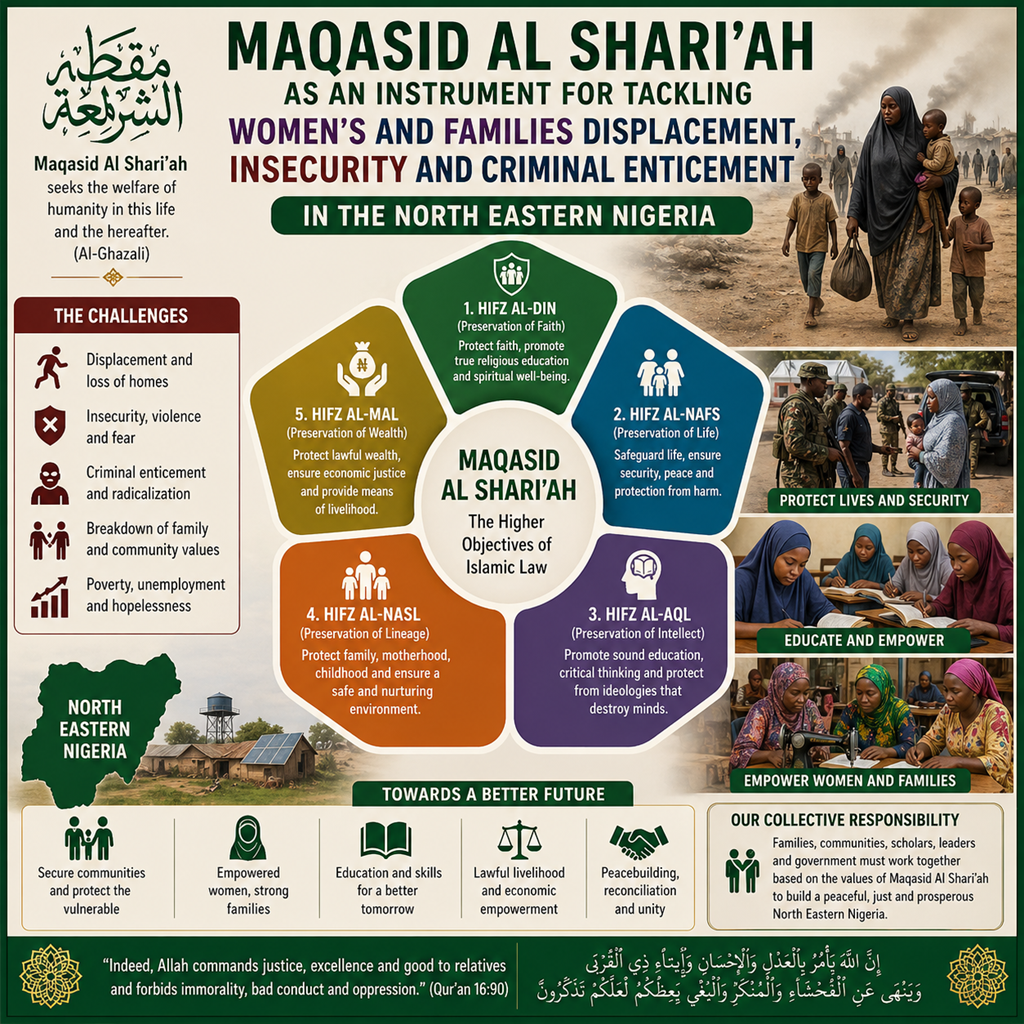
The prolonged humanitarian crisis in North Eastern Nigeria has intensified the displacement of women and families, increased insecurity, and heightened vulnerability to criminal enticement. Existing responses have largely relied on security and public policy approaches, while the Islamic normative framework remains underutilized. This article aims to examine Maqasid al-Shari’ah as a conceptual and practical instrument for addressing these challenges. Using a qualitative library-based method with a descriptive-analytical approach, the study finds that Maqasid al-Shari’ah can be operationalized through the protection of life, lineage, property, intellect, and religion, manifested in security provision, family reunification, economic assistance, education, prevention of exploitation, and the strengthening of moral values and social solidarity. Thus, Maqasid al-Shari’ah is not only normatively relevant but also provides a foundation for community-based social interventions aimed at protecting victims, strengthening families, preventing crime, and restoring the dignity of vulnerable groups. The study contributes by offering an integrative and applicable maqasid-based framework for addressing displacement, insecurity, and criminal enticement in contemporary conflict settings.
References
Abdel Haleem, M. A. S. (2010). The Qur'an: English translation and parallel Arabic text. Oxford University Press.
Abdoeh, Nor Mohammad. “Tinjauan Maqāshid Syari’ah Terhadap Pandangan Ulama Mengenai Ruislagh.” Ulul Albab: Jurnal Studi Dan Penelitian Hukum Islam 3, no. 1 (2019): 67–87. https://doi.org/https://doi.org/10.30659/jua.v3i1.7345.
Abi Ishaq Ibrahim ibn Musa ibn Muhammad al-Lakhmi asy-Syathibi. Al-Muwāfaqāt Fi Usūl Asy-Syari’ah. Jilid 2. Mesir: Maktabah at-Tijāriyah al-Kubro, 1973.
Adah, Paul Danladi, and Joy Anwuli Jegede. “Territoriality And Territorial Conflict In North Central Nigeria: Implication For National Development.” International Journal of Environmental Studies and Safety Research Safety Research 7, no. 1 (2022): 1–30.
Adegbami, A, and C C Egugbo. “Governance And Youth Empowerment Initiatives In Nigeria: To What Extent Has It Curbed Crime Rates.” Journal of Governance and Administrative Reform 6, no. 2 (2025): 194–208.
Ado, Saidu, Mohammad Abdel Salama, and Abdallah Saleh Abdallah. “The Maqasid Al-Shari’ah and the Protection of Family Economics in Islamic Law: A Reflection on Surah Al-Baqarah 2: 188.” QURU’: Journal of Family Law and Culture 3, no. 3 (2025): 264–82. https://doi.org/https://doi.org/10.59698/quru.v3i3.477.
Agbefe, Obaro Sebastine, Ikenga, Atare. “The Impact and Challenges of the Nigeria Police Force in the Maintenance of Internal Security in Nigeria.” Quest Journals: Journal of Research in Humanities and Social Science 11, no. 2 (2023): 26–35. https://www.questjournals.org/jrhss/v11-i2.html.
Akhir, Noor Shakirah Mat, and Norshabiha Ibrahim. “Analysis of Violent Act from the Islamic Spiritual Perspective.” International Journal Academic Research Business and Social Sciences 9, no. 3 (2019): 1298–1306. https://doi.org/http://dx.doi.org/10.6007/IJARBSS/v9-i3/5797.
Al-Bukhari, Muhammad. Sahih Al-Bukhari. Vol. 4. Beirut: Dar Ul-Hadith, 1978.
Al-Bukhari, Muhammad bin Ismail. “Shahih Bukhari Dan Shahih Muslim.” Dar Al-Fikr, 2002.
Al-Husein, Abu. “Shahih Muslim.” Kairo: Dar Al-Kutub, 1918.
Andesta, Vico Rahma. “Immigratoir Nigeria Dan Tindak Kejahatannya Dalam Perspektif Human Security Di Indonesia.” Universitas Satya Negara Indonesia, 2020.
Azis, Muh Ilham, Eril Eril, Andi Muh Taqiyuddin BN, Abdul Salam, and Ahmad Arief. “Maqāṣid Al-Shari’ah Theory by Imam Al-Syāṭibī.” ANAYASA: Journal of Legal Studies 2, no. 1 (2024): 17–34.
Chu, Heting. “Research Methods in Library and Information Science: A Content Analysis.” Library & Information Science Research 37, no. 1 (2015): 36–41. https://doi.org/https://doi.org/10.1016/j.lisr.2014.09.003.
Dunn, Gillian. “The Impact of the Boko Haram Insurgency in Northeast Nigeria on Childhood Wasting: A Double-Difference Study.” Conflict and Health 12, no. 1 (2018): 6.
Dusuki, Asyraf Wajdi, and Said Bouheraoua. The Framework of Maqasid Al-Shariah (Objectives of the Shari’ah) and Its Implications for Islamic Finance. International Shari’ah Research Academy for Islamic Finance (ISRA), 2011.
Imam Mawardi. Maqasid Shari’ah Dalam Pembaharuan Fiqh Pernikahan Di Indonesia. Surabaya: Pustaka Radja, 2011.
Jamaa, La. “Dimensi Ilahi Dan Dimensi Insani Dalam Maqashid Al-Syari’ah.” Asy-Syir’ah: Jurnal Ilmu Syari’ah Dan Hukum 45, no. 2 (2011).
Kamaruddin, Zaleha, Raihanah Abdullah, and Ismath Ramzy. “Managing Domestic Violence: Islamic Religious Perspective.” Journal of Dharma 40, no. 2 (2015): 189–210.
Khotimah, Umi Khusnul. “Islamic Legal Analysis on the Protection of Vulnerable Age Groups from Online Gender-Based Violence (OGBV) in Indonesia.” Journal of Ecohumanism 3, no. 8 (2024).
Manzur-E-Elahi, Mohammad, and Noor Mohammad Osmani. “The Objectives and Intents of Islamic Law as a Paradigm of Development Strategies and Policies.” Journal of Islam in Asia (E-ISSN 2289-8077) 8 (2011). https://ssrn.com/abstract=4018080.
Mayasari, Seva, and Noor Azizah. “A Review of Islamic Criminal Law on Non-Penal Policies in Combating Sexual Violence in Banda Aceh City.” Jurnal AL-MAQASID: Jurnal Ilmu Kesyariahan Dan Keperdataan 11, no. 1 (2025): 63–91. https://doi.org/https://doi.org/10.24952/almaqasid.v11i1.15282.
Muhsinin, Mahmud. “Semantics Study of the Word’Muslim’in Al-Quran.” Humanities & Social Sciences Reviews 7, no. 4 (2019): 1026–30. https://doi.org/https://doi.org/10.18510/hssr.2019.74140.
Musolli, Musolli. “Maqasid Syariah: Kajian Teoritis Dan Aplikatif Pada Isu-Isu Kontemporer.” AT-TURAS: Jurnal Studi Keislaman 5, no. 1 (2018): 60–81.
Okunade, Samuel K, and Olusola Ogunnubi. “Insurgency in the Border Communities of North-Eastern Nigeria: Security Responses and Sustainable Solutions.” The Round Table 109, no. 6 (2020): 684–700. https://doi.org/https://doi.org/10.1080/00358533.2020.1849496.
Oluku, Ochuko, and Edet Abasiekong. “The Influence of Cultural Values on Intimate Partner Violence Against Women in Nigeria: Evidence from the Literature.” Social Facts: FUOTUOKE Journal of Sociology and Anthology 4, no. 1 (2024): 45–60. https://doi.org/https://doi.org/10.5281/zenodo.14921875.
Roslan, Muhammad Mustaqim, and Anwar Osman Zainuri. “Teori Hifz Al-Nafs Dalam Maqasid Syariah: Analisis Pendalilan: The Theory of Hifz Al-Nafs in Maqasid Syariah: Argumentation Analysis.” Journal of Muwafaqat 6, no. 1 (2023): 1–13.
Savitri, Aprilliana. “Analisis Peningkatan Trafficking In Women Dari Nigeria Ke Italia Pada Tahun 2014–2016.” Universitas Brawijaya, 2018.
Udoy Saikia, Merve Hosgelen, Gouranga Dasvarm. National Human Development Report 2018. New York: United Nations Development Programme (UNDP), 2018.
Yunus, Anas Mohd. “The Relevance of Maqasid Al-Shariah in Addressing Humanitarian Crises: Insights from Surah Al-Fil.” International Journal of Academic Research in Business and Social Sciences 14, no. 12 (2024): 1–15.
Downloads
Published
How to Cite
Issue
Section
License
Copyright (c) 2026 Saidu Ado, Mohamed A. Salama, Yasser Mohamed Tarshany

This work is licensed under a Creative Commons Attribution-NonCommercial-ShareAlike 4.0 International License.
Quru': Journal of Family Law and Culture




.png)