The The Role of the Quazi Courts in Family Dispute Resolution: Effectiveness and Limitations in the Sri Lankan Context
DOI:
https://doi.org/10.59698/quru.v4i1.568Keywords:
Quazi Courts, Family Dispute, Sri Lankan Muslims, MMDAAbstract
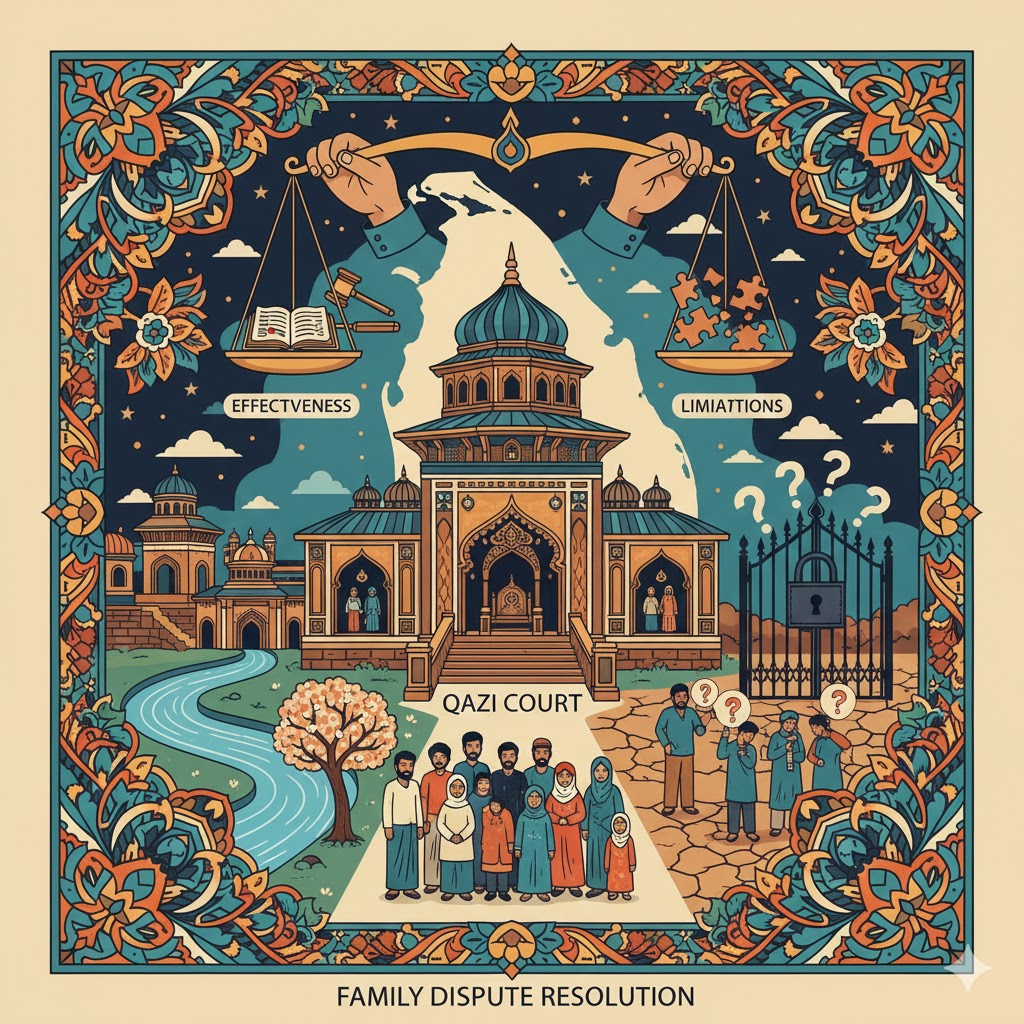
This study examines Sri Lanka’s Quazi court system and how it mediates family disputes. Beginning with an overview of the country’s mixed legal system, it highlights the application of Muslim personal law through specialized Quazi tribunals. The study assesses the strengths and weaknesses of Muslim Quazi courts, particularly within the MMDA framework. Although designed to provide more accessible and affordable family dispute resolution for the Muslim community, in practice the system raises concerns about effectiveness, legal certainty, and justice especially in relation to the protection of women’s rights. The article aims to analyze the role of Quazi Courts in resolving family disputes in Sri Lanka by evaluating their effectiveness, identifying structural and procedural limitations under the MMDA, and mapping their implications for gender equality and access to justice. The research adopts a qualitative socio-legal approach using secondary data through document review and doctrinal analysis. Sources include the MMDA, academic literature, institutional reports, and comparative studies on religion-based family courts within the context of legal pluralism. The data are analyzed through deductive thematic analysis to extract key themes such as operational weaknesses, gender disparities in the MMDA, impacts on women, and reform challenges. The findings indicate that Quazi Courts offer access-related advantages (low cost, opportunities for self-representation, and relatively rapid processing for simple cases), but their effectiveness is constrained by the lack of minimum qualifications and formal training for Quazis, irregular hearing schedules, inadequate infrastructure, weak oversight, and alleged corrupt practices. Normatively, several MMDA provisions are seen to reinforce gender inequality (child marriage, mandatory male guardianship, divorce procedures that disadvantage women, polygamy without strict scrutiny, and the absence of post-divorce property distribution rules), thereby weakening women’s protection and the overall quality of justice. This article recommends comprehensive MMDA reform (setting a minimum marriage age, strengthening women’s agency, ensuring equality in divorce procedures, regulating polygamy with strict safeguards, and establishing property division mechanisms), professionalizing and standardizing Quazi Courts (minimum qualifications, mandatory training, a code of ethics, effective supervision, and adequate court facilities).
References
Abduroaf, Muneer, and Najma Moosa. “Muslim Marriage and Divorce in Sri Lanka: Aspects of the Relevant Jurisprudence.” Electronic Journal of Islamic and Middle Eastern Law 4 (2016). https://heinonline.org/HOL/Page?handle=hein.journals/elcjloic4&id=105&div=&collection=.
Ahmed, Farrah. “Personal Autonomy and the Option of Religious Law.” International Journal of Law, Policy and the Family 24, no. 2 (August 1, 2010): 222–44. https://doi.org/10.1093/lawfam/ebq006.
ATHAR, SYED MUJTABA. “HISTORICAL DEVELOPMENT OF THE ROMAN-DUTCH LEGAL TRADITION IN SRI LANKA.” RUSSIAN LAW JOURNAL 8, no. 2 (2024): 348–53.
Chandrahasan, P. “Pragmatic Approaches Towards Fundamental Rights Litigation Procedure in Srilanka : Challenges and Opportunities.” In INTERNATIONAL RESEARCH CONFERENCE ARTICLES (KDU IRC), 2012:227–36. General Sir John Kotelawala Defence University, Sri Lanka, 2012. http://ir.kdu.ac.lk/handle/345/8499.
Chiba, Masaji. “Legal Pluralism in Sri Lankan Society.” The Journal of Legal Pluralism and Unofficial Law 25, no. 33 (1993): 197–212. https://doi.org/10.1080/07329113.1993.10756450.
Cooray, Anton. “Access to Non-Judicial Justice Through Islamic Courts in Sri Lanka: Palm Tree Justice or Accessible Justice?” Asia Pacific Law Review 20, no. 1 (2012): 113–34. https://doi.org/10.1080/10192557.2012.11788257.
Dawood, Shamila. “Islamic Law and Gender Equality : Challenges and Reforms in Sri Lanka ’ s Muslim Marriage and Divorce Act.” Journal of Islamic Law Review 5, no. 2 (2024): 288–305.
———. “Islamic Law and Gender Equality : Challenges and Reforms in Sri Lanka ’ s Muslim Marriage and Divorce Act.” Journal of Islamic Law 5, no. 2 (2024): 288–305. https://doi.org/https://doi.org/10.24260/jil.v5i2.2833.
———. “Married Women Property Rights under Muslim Marriage and Divorce Act of Sri Lanka : A Critical Analysis.” ATSK Journal of Law 1, no. 1 (2024): 33–41. https://www.researchgate.net/profile/Shamila-Dawood-2/publication/380164573_Married_Women_Property_Rights_under_Muslim_Marriage_and_Divorce_Act_of_Sri_Lanka_A_Critical_Analysis/links/662e6d1006ea3d0b7413d2ac/Married-Women-Property-Rights-under-Muslim-Marr.
Fowzul, M B. “Fixing the Legal Age of Marriage in the MMDA of Sri Lanka: An Islamic Analysis.” In Intellectual Discourse on Proposed Reformation of the Muslim Marriage and Divorce Act (MMDA), 103–15. Faculty of Islamic Studies & Arabic Language, South Eastern University of Sri Lanka, 2024. http://ir.lib.seu.ac.lk/handle/123456789/7150.
———. “The Judgements of Quazi Courts in Sri Lanka: An Analysis.” Muallim Journal of Social Sciences and Humanities, 4, no. 1 (2020): 1–15. https://doi.org/https://doi.org/10.33306/mjssh/50.
Fowzul, Mohamed Buhary. “The Requirement of Muslim Marriage Registration in Sri Lanka: From the Maqasid Al-Shari’ah Perspective.” Global Journal of Arts Humanities and Social Sciences 4, no. November (2024): 11. https://doi.org/10.5281/zenodo.14228890.
———. “The Views of The Women Activists in Sri Lanka OnThe Validity of WalīinA Marriage: A Juristic Analysis.” AL-HIKMAH: INTERNATIONAL JOURNAL OF ISLAMIC STUDIES AND HUMAN SCIENCES 4, no. 3 (2021): 412–35. https://doi.org/https://doi.org/10.46722/hikmah.v4i3.160.
Fowzul, Mohamed Buhary, and Sayed Sikandar Shah Haneef. “Women’s Advocacy for Imposing Stringent Stipulations on Polygamy in Muslim Marriage and Divorce Act of Sri Lanka: A Juristic Analysis.” International Journal for Studies on Children, Women, Elderly And Disabled 11 (2020): 1–9. https://www.ijcwed.com/wp-content/uploads/2020/09/IJCWED11_008.pdf.
Ismath Ramzy, Mohammad, and Simin Ghavifekr. “Women Quazi in a Minority Context: An Overview of Sri Lankan Experience.” Societies 9, no. 1 (2019). https://doi.org/10.3390/soc9010013.
Jazeel, M.I.M., and M.B. Fowzul. “Quazi Court Practices in Muslim Family Disputes: A Case Study on Quazi Courts of Sri Lanka.” Nithal Published by Faculty of Arts & Culture, Eastern University of Sri Lanka 10, no. 2 (2021): 142–56. http://ir.lib.seu.ac.lk/handle/123456789/5977.
———. “இலங்கையில் நியமனம் பெறும் காழிகளின் நடத்தைகள்: ஓர் இஸ்லாமிய, கள அனுபவப் பகுப்பாய்வு.” Sri Lankan Journal of Arabic and Islamic Studies 2, no. 1 (2019): 15–30. http://seu.ac.lk/sljais/.
Mazahir, S. M. M., and M. M. A. Abdullah. “The Appointment of Women Quazi in Sri Lankan Muslim Minority Context: An Analysis.” In Intellectual Discourse on Proposed Reformation of the Muslim Marriage and Divorce Act (MMDA), edited by South Eastern University of Sri Lanka Faculty of Islamic Studies & Arabic Language, 163–81. Faculty of Islamic Studies & Arabic Language, South Eastern University of Sri Lanka, 2024. http://ir.lib.seu.ac.lk/handle/123456789/7140.
Moosa, Muneer Abduroaf and Najma. “Muslim Marriage and Divorce in Sri Lanka: Aspects of the Relevant Jurisprudence.” Ejimel Eloctronic Journal of Islamic and Middle Eastern Law 4 (2016): 97–108. http://www.ejimel.uzh.ch.
MPLRAG: Muslim Personal Law Reform Action Group. “Maintanace under MMDA,” 2021. https://www.mmdasrilanka.org/maintenance-under-the-mmda/.
MPLRAG. “FAMILY COURT SYSTEM FOR A REFORMED MUSLIM MARRIAGE AND DIVORCE ACT ( MMDA ),” 2022. https://www.mmdasrilanka.org/wp-content/uploads/2022/03/ENG-MPLRAG-Position-paper-Imagining-a-Family-Court-System.pdf.pdf.
MPLRAG, Muslim Personal Law Reform Action Group. “What Is the Muslim Marriage and Divorce Act ( MMDA )?” MPLRAG, Muslim Personal Law Reform Action Group, 2017. https://www.mmdasrilanka.org/aboutmmda/?utm_source=chatgpt.com.
Mufas, T Mohamed, and C Sivanayagam. “Challenges Faced by Quazi Court and Its Resolutions in Contemporary Sri Lanka.” Indian Journal of Musti Research and Development 4, no. 2 (2023): 26–32. https://doi.org/10.54392/ijmrd2324.
Rajeev, B. “Muslim Women Protection of Rights on Marriage Act and Divorce of Muslim Women in Malappuram District” 14 (2022): 201–13.
Sabir, M. M. M., and M. I. M. Ameen. “Quazi Court and Administrative Integrity.” In Intellectual Discourse on Proposed Reformation of the Muslim Marriage and Divorce Act (MMDA), 151–62. Faculty of Islamic Studies & Arabic Language, South Eastern University of Sri Lanka, Oluvil., 2024. http://ir.lib.seu.ac.lk/handle/123456789/7142.
Saleem, Marsoof. The Quazi Court System in Sri Lanka and Its Impact on Muslim Women. First. Colombo 5,Sri Lanka: Muslim Women’s Research and Ac t on Forum (MWRAF), 73/19 E Kirulapone Avenue, 2011. https://www.academia.edu/30277198/The_Quazi_Court_System_in_Sri_Lanka_and_its_Impact_on_Muslim_Women.
Saujan, Iqbal. “Female Quazi Appointed in the Judicial Position : Islamic Law and Public Opinion in Sri Lankan Context .” IOSR Journal of Humanities and Social Science 24, no. October (2021): 57–64. https://doi.org/10.9790/0837-2410075764.
Saujan, Iqbal, Yusuf Sani Abubakr, and Seeni Mohamed Mohamed. “Gender Beyond Binary : Inheritance Rights of Third Gender in Islamic Law – Sri Lankan Legal Recognition and Reform.” Indonesian Journal of Islamic Law 8, no. 2 (2025): 142–66. https://doi.org/https://doi.org/10.35719/ijil.v5i2.
Saujan, Iqbal, Mohamed Haniffa, and Mohamed Nairoos. “Re-Marriage Practice Amongst Muslim Women: A Social Study.” Cognizance Journal of Multidisciplinary Studies 2, no. June (2022): 13–35. https://doi.org/10.47760/cognizance.2022.v02i05.002.
Saujan, Iqbal, and Seyed Mohamed Mohamed Mazahir. “Legal and Practical Issues in the Management of Waqf Properties in Sri Lanka.” International Journal of Sukuk and Waqf Research 2, no. 1 (2021): 18–31. https://doi.org/10.46281/ijswr.v2i1.1646.
Saujan, Iqbal, Seeni Mohamed, Mohamed Nafees, and Iqbal Subhan Nugraha. “Safeguarding Women ’ s Rights and Heirship : An Evaluation of Mandatory Muslim Marriage Registration in Sri Lanka.” Quru’: Journal of Family Law and Culture 3, no. 3 (2025): 238–63. https://doi.org/https://doi.org/10.59698/quru.v3i3.462.
Saujan, Iqbal, Seeni Mohamed Mohamed Nafees, and Yusuf Sani Abubakar. “The Causes and Consequences of Child Marriage Among Muslim Community : With Special Reference to the Cases Identified in the Eastern Province of Sri The Causes and Consequences of Child Marriage Among Muslim Community : With Special Reference to the Cases.” Quru’: Journal of Family Law and Culture 2, no. 3 (2024): 278–305. https://doi.org/https://doi.org/10.59698/quru.v2i3.214.
Schenk, Christine G., and Shalul Hasbullah. “Informal Sovereignties and Multiple Muslim Feminisms: Feminist Geo-Legality in Sri Lanka.” Political Geography 94 (April 1, 2022): 102527. https://doi.org/10.1016/J.POLGEO.2021.102527.
Schenk, Christine G, and Shalul Hasbullah. “Informal Sovereignties and Multiple Muslim Feminisms: Feminist Geo-Legality in Sri Lanka.” Political Geography 94 (2022): 102527. https://doi.org/https://doi.org/10.1016/j.polgeo.2021.102527.
Silva, R., E. Souza, and S. Simelane. “Marriage , Divorce Registration and Vital Statistics.” Centre of Excellence for CRVS Systems, United Nations Population Fund., 2024. https://idl-bnc-idrc.dspacedirect.org/bitstreams/c1ebfb9b-6564-4126-b1a5-9161f17be13d/download.
Sivakajan, Sivakumar. “Muslim Marriage and Divorce Act (1957) of Sri Lanka ; Critically Analysed the Inequalities in the Muslim Childeren, Women, Quazi Court System and Overlaping with General Law in Sri Lanka.” Journal of Islamic Law 5, no. 2 (2024): 288–305. https://doi.org/https://doi.org/10.24260/jil.v5i2.2833.
Sulaiman Lebbe, Rifai. “Arab and Muslim Settlements in Sri Lanka from Pre-Islamic Periods to 16 Th Century A . D . Dr SLM RIFAI.” Available at SSRN, 2021, 1–17. https://doi.org/https://dx.doi.org/10.2139/ssrn.3815477.
Wettimuny, Shamara, and Hana Rajap. “Reforming the Muslim Marriage and Divorce Act,” 2018. https://archive.veriteresearch.org/handle/456/5230.
Wijeyesekera, Rose. “A Critical Evaluation of the Law of Divorce under the General Law and Special Laws of Sri Lanka.” University of Colombo, Sri Lanka, 2003. https://www.academia.edu/download/68239778/A_Critical_Evaluation_of_the_Law_of_Divorce_Under_General_Law_and_Special_Laws_of_Sri_Lanka.pdf.
Downloads
Published
How to Cite
Issue
Section
License
Copyright (c) 2026 Nazar Kany, SMM. Nafees

This work is licensed under a Creative Commons Attribution-NonCommercial-ShareAlike 4.0 International License.
Quru': Journal of Family Law and Culture




.png)